


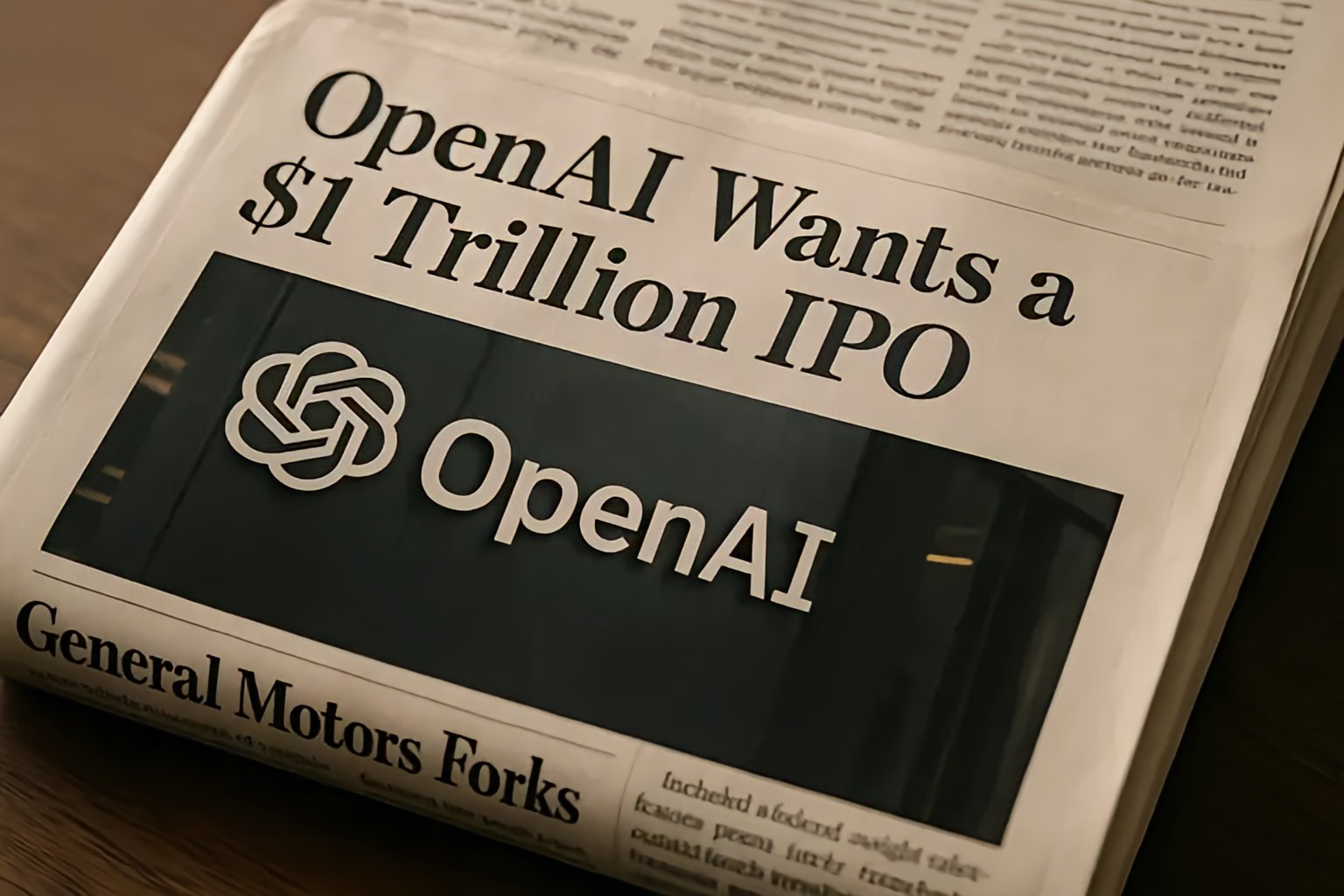
OpenAI is making one of the boldest bets in modern technology history. The company is preparing to spend well over $1 trillion on massive AI-focused data centers, signaling its belief that artificial intelligence will soon dominate global productivity, innovation, and economic growth. However, this enormous commitment comes at a time when OpenAI’s financial fundamentals are under strain, prompting growing concerns among economists, researchers, and industry watchers.
The OpenAI trillion dollar AI investment represents a scale of ambition rarely seen in the private sector. While the company positions this move as essential for powering next-generation AI models, critics warn that the costs may be racing ahead of real-world value creation.
Sam Altman Admits OpenAI Is Slowing Hiring Amid Rising Costs
During a recent town hall livestream, OpenAI CEO Sam Altman acknowledged that the company is burning through billions of dollars each quarter. As a result, OpenAI plans to “dramatically slow down” hiring in the near future. This admission highlights a growing tension inside the company: massive infrastructure expansion on one hand, and financial caution on the other.
Altman’s comments suggest that even OpenAI recognizes the risks of scaling too quickly. Slowing hiring is a clear signal that profitability and sustainability are becoming more pressing concerns, despite the company’s long-term confidence in AI’s transformative potential.
AI as a Deflationary Force: Altman’s Bold Economic Claim
Despite cost pressures, Altman remains deeply optimistic about AI’s economic impact. He has repeatedly argued that advanced AI will be “massively deflationary,” lowering prices across industries and increasing individual purchasing power. According to him, AI-driven productivity gains could fundamentally reshape how value is created and distributed.
Altman believes that as AI becomes more capable, individuals will be able to accomplish tasks that once required entire teams. He claims that by the end of this year, spending around $1,000 on AI inference could enable a single person to build complex software in a fraction of the time previously required.
Productivity Gains and the Promise of Radical Cost Reduction
At the heart of the OpenAI trillion dollar AI investment is the assumption that AI will dramatically boost productivity. Altman argues that this productivity explosion will make goods and services “radically cheaper,” empowering individuals while making money more valuable.
This vision represents a dramatic shift from traditional economic models, which have historically been inflationary. If AI truly lowers production costs at scale, it could challenge long-held assumptions about labor, wages, and economic growth.
A Familiar Narrative in Silicon Valley’s AI Hype Cycle
The idea that AI will usher in an era of abundance is not new. Tech Insider and leaders such as Elon Musk and Anthropic CEO Dario Amodei have also suggested that AI could reduce the need for work, eliminate poverty, and dramatically lower the cost of living.
Altman has echoed these views in previous statements, including remarks at a closed-door Morgan Stanley conference where he claimed AI would have a deflationary impact on the global economy. However, critics argue that such claims remain largely theoretical and lack support from current data.
Reality Check: Inflation, Interest Rates, and Economic Pressure
While AI leaders talk about abundance, the broader economy tells a different story. Inflation remains elevated, prompting the US Federal Reserve to hold interest rates steady. The cost of living continues to rise, especially in major cities, placing increased pressure on households.
So far, AI has not meaningfully offset these challenges. The gap between AI’s promised benefits and everyday economic reality remains wide, casting doubt on whether the OpenAI trillion dollar AI investment will deliver its expected returns anytime soon.
AI and Job Losses: A Growing Concern
Rather than boosting employment, AI has frequently been associated with layoffs and workforce restructuring. Long-term unemployment recently hit a four-year high, as many displaced workers struggle to find new roles.
For many employees, AI tools have failed to deliver tangible productivity benefits. Surveys indicate that workplace AI use is declining, with some workers describing it as ineffective or irrelevant to their daily tasks. This trend directly contradicts the narrative that AI is already transforming productivity.
Researchers Question AI’s Real Productivity Impact
Academic researchers have raised serious concerns about AI’s effectiveness in its current form. Multiple studies suggest that AI has not yet delivered the widespread productivity gains promised by its developers.
In many cases, AI systems require extensive oversight, correction, and integration work, limiting their net benefit. These findings have fueled skepticism about whether massive infrastructure spending can truly translate into economic transformation.
OpenAI’s Business Model Faces Growing Scrutiny
To critics, OpenAI’s aggressive expansion resembles a high-risk gamble. Some analysts have warned that the company could be vulnerable to financial shocks if investor confidence falters or revenue growth fails to keep pace with costs.
The idea that OpenAI could be “one run on the banks away” from serious trouble has gained traction among skeptics who question the long-term viability of large-scale AI spending without clear profitability.
Grand Promises vs Present-Day Limitations
Sam Altman has made some of the most ambitious claims in tech history, suggesting AI could cure cancer, solve climate change, and eliminate financial hardship through what he calls “universal extreme health.” While these ideas capture public imagination, they also invite skepticism.
Similarly, Musk has predicted a future without poverty, while Amodei has suggested AI could dramatically reduce working hours. Yet, for now, these visions remain far ahead of measurable outcomes.
Even Altman Acknowledges the Risks
Interestingly, Altman himself has expressed uncertainty about whether sudden abundance would benefit everyone equally. He has warned that poor policy decisions could undermine AI’s potential as an equalizing force.
He emphasized that while AI could lower costs and expand access to opportunity, the outcome depends heavily on how governments and institutions manage the transition. Without careful policy planning, AI-driven abundance could deepen inequality rather than reduce it.
OpenAI Trillion dollar AI investment
The OpenAI trillion dollar AI investment represents a defining moment for the AI industry. It reflects extraordinary confidence in a future shaped by artificial intelligence, but also exposes the gap between visionary promises and present-day realities.
As OpenAI slows hiring, burns through capital, and faces growing skepticism, the success of its strategy remains far from guaranteed. Whether AI will truly deliver deflation, abundance, and empowerment or fall short of its lofty goals will determine whether this trillion-dollar bet becomes a triumph or a cautionary tale.