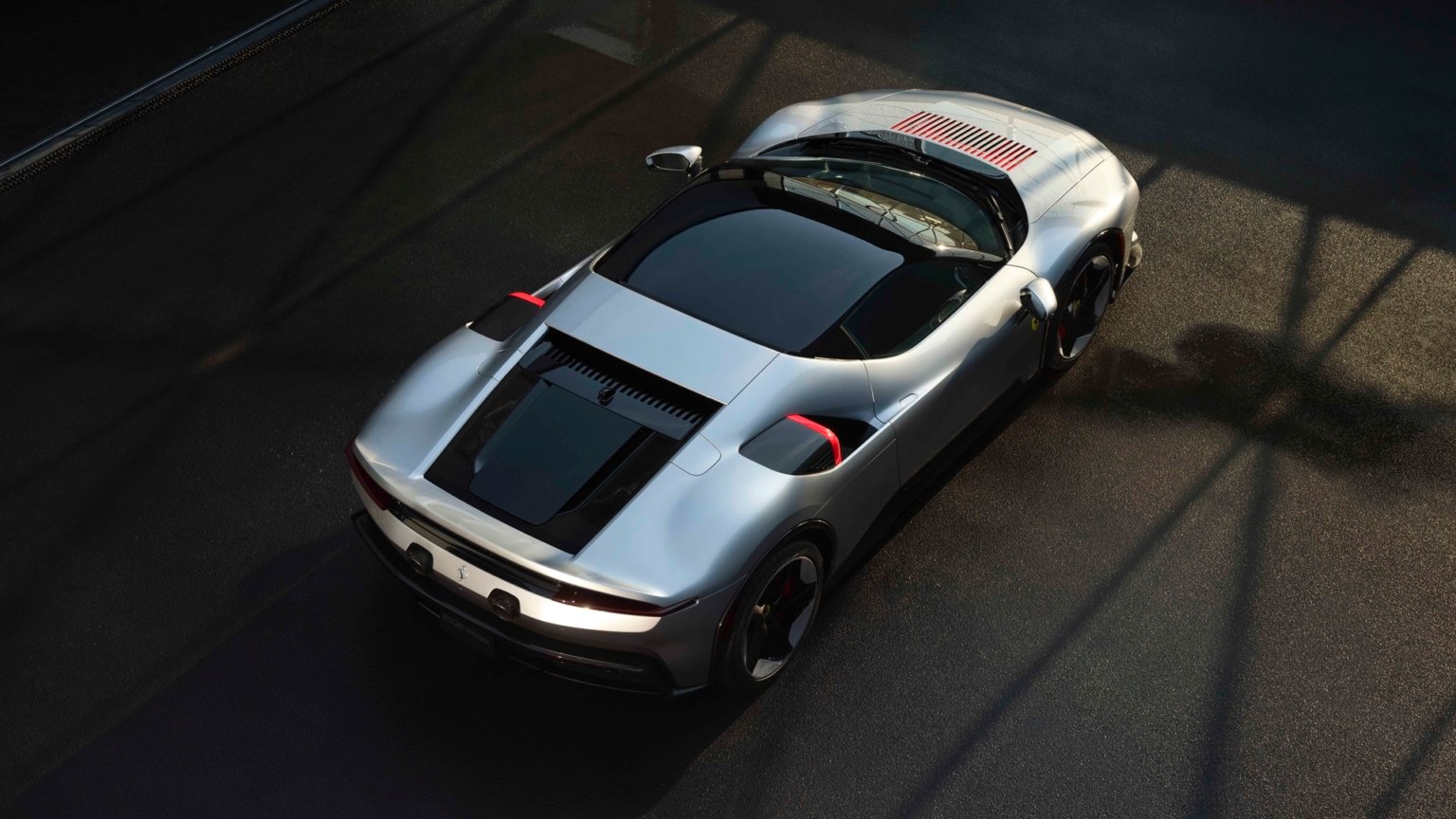

The Ferrari CZ26 is the kind of car that makes you look twice before you decide what you are actually seeing. At first glance, the Ferrari CZ26 appears to borrow heavily from the design language of the Ferrari Luce, the company’s first fully electric production model. Look underneath that dramatic body, however, and the story changes. The Ferrari CZ 26 is mechanically based on the Ferrari SF90 Stradale, complete with its twin-turbocharged V8 and plug-in hybrid system.
That combination is what makes the Ferrari CZ26 so fascinating. It is not an electric Ferrari wearing a combustion engine as an afterthought. It is a Ferrari SF90 underneath a completely reworked body that explores where Ferrari design could go next.
Ferrari unveiled the Ferrari CZ 26 at Monterey as a Special Projects commission created for a US client. The project reportedly took about two years from the initial idea to the completed car. Ferrari Design Studio, led by Flavio Manzoni, was responsible for the design.
The result is a one-off supercar that feels less like another variation of an existing Ferrari and more like a design experiment that escaped the studio.
What exactly is the Ferrari CZ26
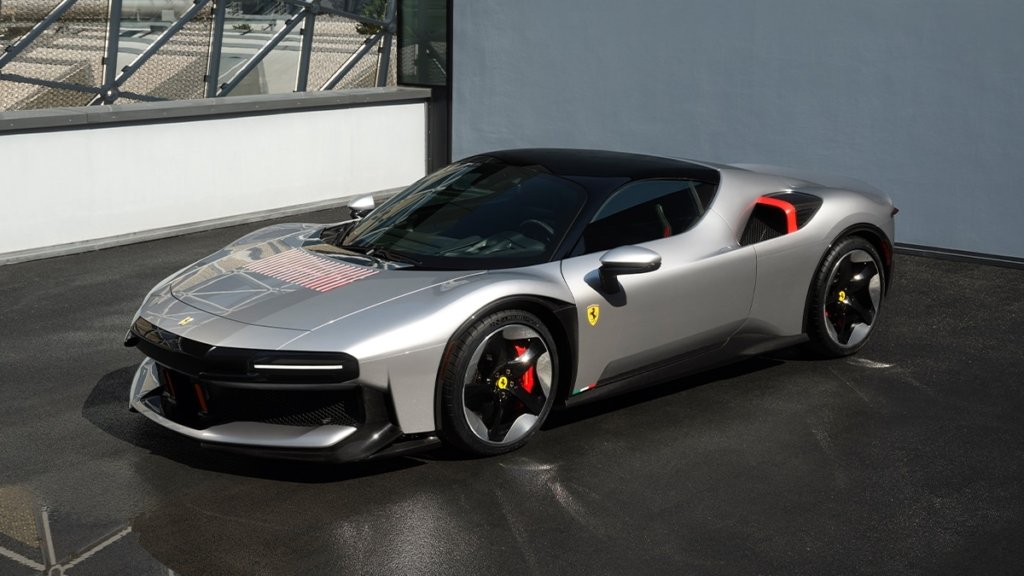
The Ferrari CZ26 belongs to Ferrari’s Special Projects program. This is where the company creates highly bespoke cars around an individual client’s brief rather than developing a model intended for conventional series production.
That distinction matters. The Ferrari CZ 26 is not a new replacement for the SF90. It is not a limited production model that Ferrari plans to sell to hundreds of customers. It is a single commission, which means many of its most unusual design decisions exist because one customer wanted something that could not simply be ordered from a normal Ferrari configurator.
Ferrari has confirmed that the mechanical specification remains that of the SF90 Stradale. That means the Ferrari CZ26 uses a 3.9-litre twin-turbocharged V8 producing 797 cv, supported by electric motors delivering 162 kW. Its battery capacity is 7.9 kWh, while Ferrari quotes a 0 to 100 km/h time of 2.5 seconds and a top speed of 328 km/h. Electric-only driving is rated at 25 km.
So while the Ferrari CZ 26 looks radically different, its performance hardware is familiar. That may actually be the smartest part of the project.
The Ferrari CZ26 looks like the Luce went back to the drawing board.
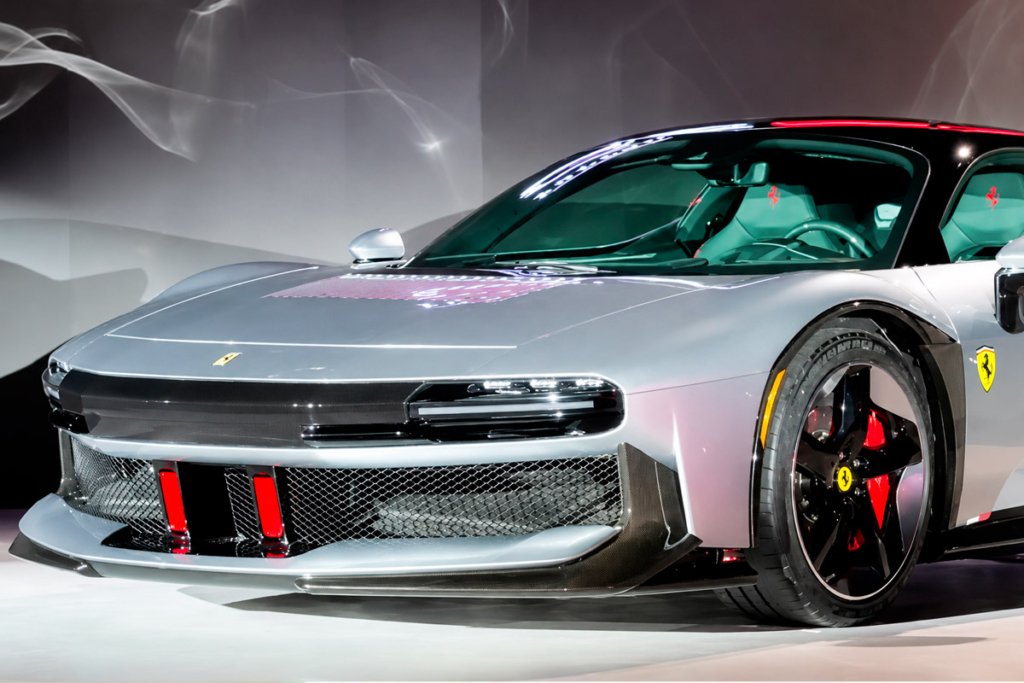
The biggest visual connection between the Ferrari CZ26 and the Luce is the front end. The Ferrari CZ 26 uses a broad horizontal graphic across the nose, with extremely slim lighting elements integrated into it. Ferrari also incorporates sensors and brake cooling hardware into this visual band.
The effect is very different from the traditional Ferrari approach of making the grille and headlights obvious individual elements. Instead, the Ferrari CZ 26 tries to make the front of the car appear almost like one continuous technical surface.
That approach is closely related to the Ferrari Luce design language. The Luce uses horizontal visual elements, concealed lighting and a clean front treatment intended to make the technology feel integrated rather than exposed.
Interestingly, Ferrari itself does not simply describe the Ferrari CZ 26 as a Luce derivative. The company instead points toward Italian industrial design from the 1970s as an important inspiration. That distinction is worth noting because it prevents an easy assumption from becoming a fact. The visual resemblance to the Luce is clear, but Ferrari’s official explanation gives the design a broader historical context.
The Ferrari CZ26 has a completely different body strategy.
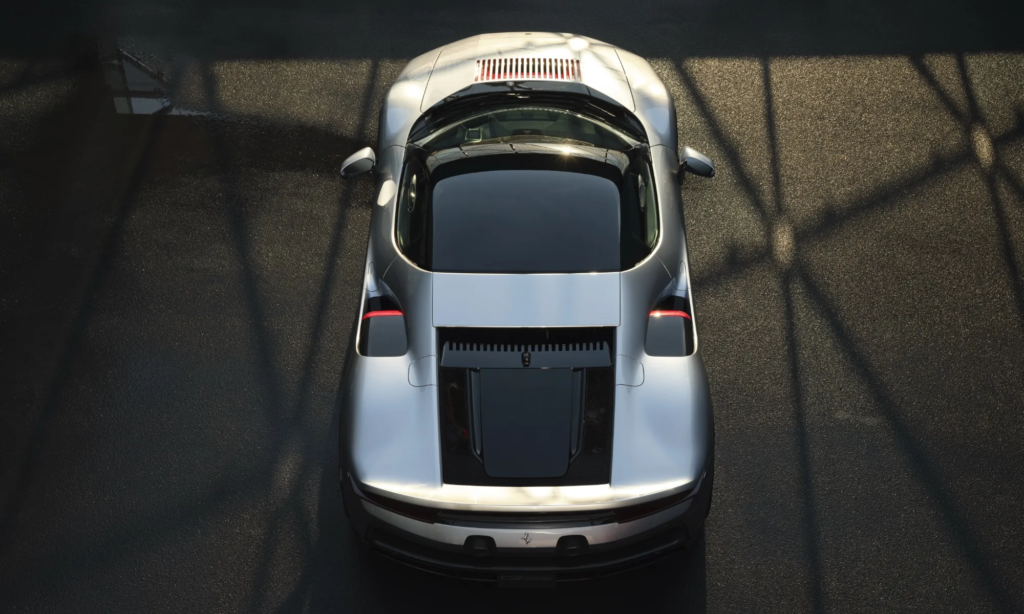
The Ferrari CZ26 does not merely receive a new bumper and headlights. Almost everything above the mechanical hard points has been reconsidered.
Ferrari gives the car a two-box silhouette with a central capsule-like cabin and pronounced wheel arch volumes. The rear has been shortened visually and incorporates cantilevered taillights. The body also receives new aerodynamic components, including revised cooling channels, bypass ducts, air curtains, a new rear spoiler, and a redesigned diffuser.
This is where the Ferrari CZ26 becomes more interesting than a simple styling exercise. The designers have not treated aerodynamics as something that should be hidden beneath beautiful surfaces. The body itself communicates that the car is designed around airflow.
That makes sense for a car based on the SF90. The underlying platform already has serious performance capability, so giving the exterior a more technical identity is not simply cosmetic.
The Ferrari CZ26 is effectively asking what an SF90 could look like if its body were designed without having to preserve the familiar SF90 silhouette.
The Ferrari CZ26 keeps the V8 at the center of the story.
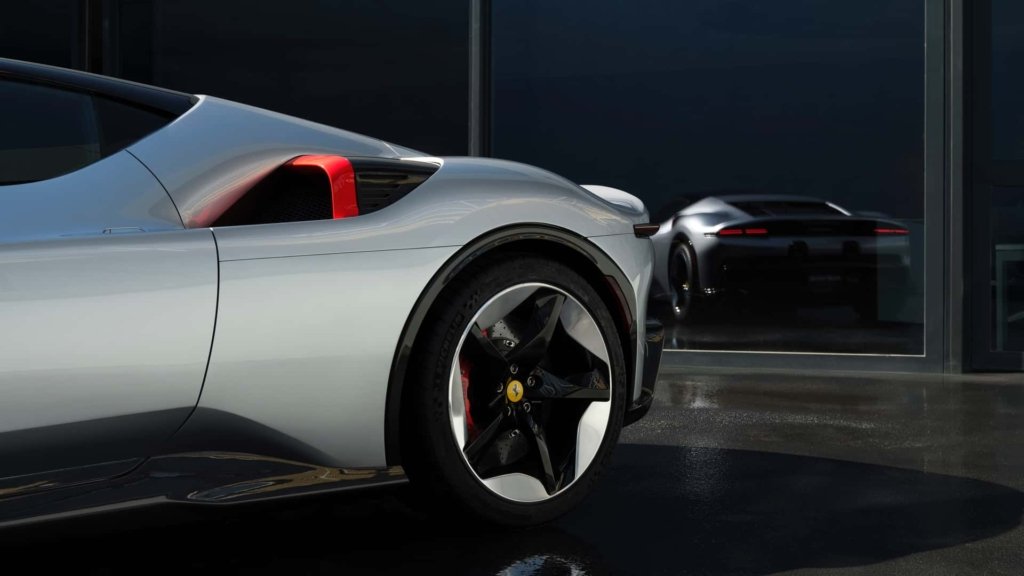
There is an important contradiction at the heart of the Ferrari CZ26. Its appearance suggests Ferrari’s electric future. Its mechanical identity belongs to Ferrari’s hybrid present. That tension is exactly why the Ferrari CZ26 works so well as a conversation piece.
The car carries the visual vocabulary associated with the Luce while retaining the twin-turbo V8 and three-motor hybrid architecture of the SF90. In practical terms, that gives the Ferrari CZ26 a very different personality from a pure battery electric car.
It can use electric power for short distances, but its defining power source remains the combustion engine. The 7.9 kWh battery and 25 km electric range also underline the difference between this car and a dedicated battery electric Ferrari. The battery is there to support the hybrid system rather than turn the Ferrari CZ26 into a long-range electric grand tourer.
That makes the Ferrari CZ26 an interesting snapshot of Ferrari during a period when the company is developing both electrification and combustion-powered performance cars.
Why the Ferrari CZ26 matters beyond being a one-off
It would be easy to dismiss the Ferrari CZ26 as an extraordinarily expensive toy for one anonymous customer. That would miss the bigger point.
Ferrari has historically used special projects to explore ideas that would be difficult to justify on a conventional production model. A one-off gives designers far more freedom because they do not have to solve the same manufacturing, market positioning and volume production problems associated with a normal model.
The Ferrari CZ26 therefore provides a useful glimpse into Ferrari’s thinking. The company can experiment with concealed lighting, horizontal proportions, unusual cabin graphics, new aerodynamic treatments and different relationships between the body and wheels without committing an entire model line to those ideas.
Whether every detail survives into future Ferraris is impossible to know. But the Ferrari CZ26 demonstrates that Ferrari is willing to push its visual identity into unfamiliar territory.
Ferrari CZ26 compared with the SF90 Stradale.
The simplest way to understand the Ferrari CZ26 is to separate its mechanical identity from its visual identity. The SF90 Stradale provides the engineering foundation. Its twin-turbo V8, electric motors, battery, transmission, and performance figures remain central to the Ferrari CZ26. The Ferrari CZ26 then changes the experience around that hardware.
Its exterior is lower in visual complexity and more horizontal. Its front end looks more integrated. Its rear treatment is shorter and more sculptural. The cabin is presented as a capsule within the body rather than simply another conventional supercar cockpit.
That means the Ferrari CZ26 is not necessarily faster than an SF90 Stradale. It is different. And with a Special Projects Ferrari, difference is often the entire point.
The Ferrari CZ26 also brings the Luce debate back into focus.
The arrival of the Ferrari CZ26 is particularly interesting because the Luce has already generated strong reactions. The Luce faced criticism when it was revealed, yet Ferrari reportedly sold its roughly 500-car 2026 allocation at €550,000 in less than two months. Ferrari CEO Benedetto Vigna also said demand continued despite the controversy surrounding the design.
The Ferrari CZ26 therefore arrives at an interesting moment. Instead of abandoning the visual ideas associated with the Luce, Ferrari has adapted some of them to a very different type of car. That suggests the Luce design language may be more important to Ferrari’s future thinking than early criticism implied.
The Ferrari CZ26 almost feels like a test of the same design philosophy in a more familiar performance context. And perhaps that is why it looks more convincing to some observers.
What makes the Ferrari CZ26 special inside
The exterior gets most of the attention, but the Ferrari CZ26 also receives a bespoke interior. Ferrari has used technical materials and custom details to distinguish the cabin from the standard SF90 environment. The result is intended to match the more experimental character of the exterior rather than simply transplanting the production car’s interior unchanged.
That approach is important with a Special Projects vehicle. If Ferrari had only redesigned the exterior, the Ferrari CZ26 would feel like a body conversion. By reworking the cabin as well, Ferrari creates the impression of a complete design concept. It becomes one coherent object rather than an SF90 wearing a different skin.
Could Ferrari CZ26 design influence future models
This is the question enthusiasts will probably debate for years. There is no confirmed evidence that Ferrari intends to put the Ferrari CZ26 into production or directly transfer its design to another model. Still, several elements are worth watching.
The horizontal front treatment is particularly significant because it creates a visual connection between an electric Ferrari and a hybrid supercar. The capsule-like cabin treatment also offers Ferrari another way to make future cars look more sculptural without relying entirely on traditional supercar proportions.
The aerodynamic surfaces are equally interesting. If Ferrari continues exploring this direction, future models could become more visually technical while remaining recognizably Ferrari. For now, that remains an informed observation rather than a confirmed product plan.
Ferrari CZ26 is a fascinating snapshot of Ferrari in transition.
The Ferrari CZ26 is ultimately more than a strange-looking SF90. It represents a moment when Ferrari is trying to balance several identities at once. There is the traditional Ferrari identity built around a dramatic combustion engine.
There is the increasingly important hybrid identity represented by cars such as the SF90. And there is the electric future represented by the Luce. The Ferrari CZ26 places those three ideas remarkably close together. That is why the car deserves attention even if only one example exists.
From an enthusiast perspective, the most interesting question is not whether the Ferrari CZ26 is beautiful. Design will always be subjective. The more important question is whether Ferrari has found a convincing way to make advanced technology look unmistakably Ferrari. The answer is still being written.
Ferrari CZ26 shows why one-off Ferraris matter
The Ferrari CZ26 would probably be less interesting if Ferrari had built another faster SF90. Instead, the company used one customer commission to explore an unusual design direction while retaining proven hybrid performance hardware.
That is precisely what makes Special Projects valuable. The Ferrari CZ26 gives us something rare in the modern car industry: a production-based Ferrari that can behave almost like a rolling design study. It also creates a compelling visual thought experiment.
Imagine the Luce and SF90 meeting in a design studio, keeping the Luce’s futuristic face while borrowing the SF90’s mechanical character. That is essentially the Ferrari CZ26. And whether you love or dislike the styling, it is difficult to argue that Ferrari has played it safe.
Final verdict on the Ferrari CZ26
The Ferrari CZ26 is not a new Ferrari model, and it should not be judged as one. It is a one-off Special Projects creation built around the SF90 Stradale’s established hybrid powertrain and wrapped in a completely new interpretation of Ferrari design. Its relationship with the Luce is visually obvious, although Ferrari officially frames its inspiration more broadly around Italian industrial design.
The Ferrari CZ26 is therefore best understood as a bridge between Ferrari’s present and future. It has the heart of an SF90, the visual confidence of a design experiment and several cues associated with Ferrari’s electric era.
That combination makes the Ferrari CZ26 one of the more intriguing Ferrari one-offs to emerge in recent years. For anyone interested in where Ferrari design is heading, the Ferrari CZ26 is worth watching closely.