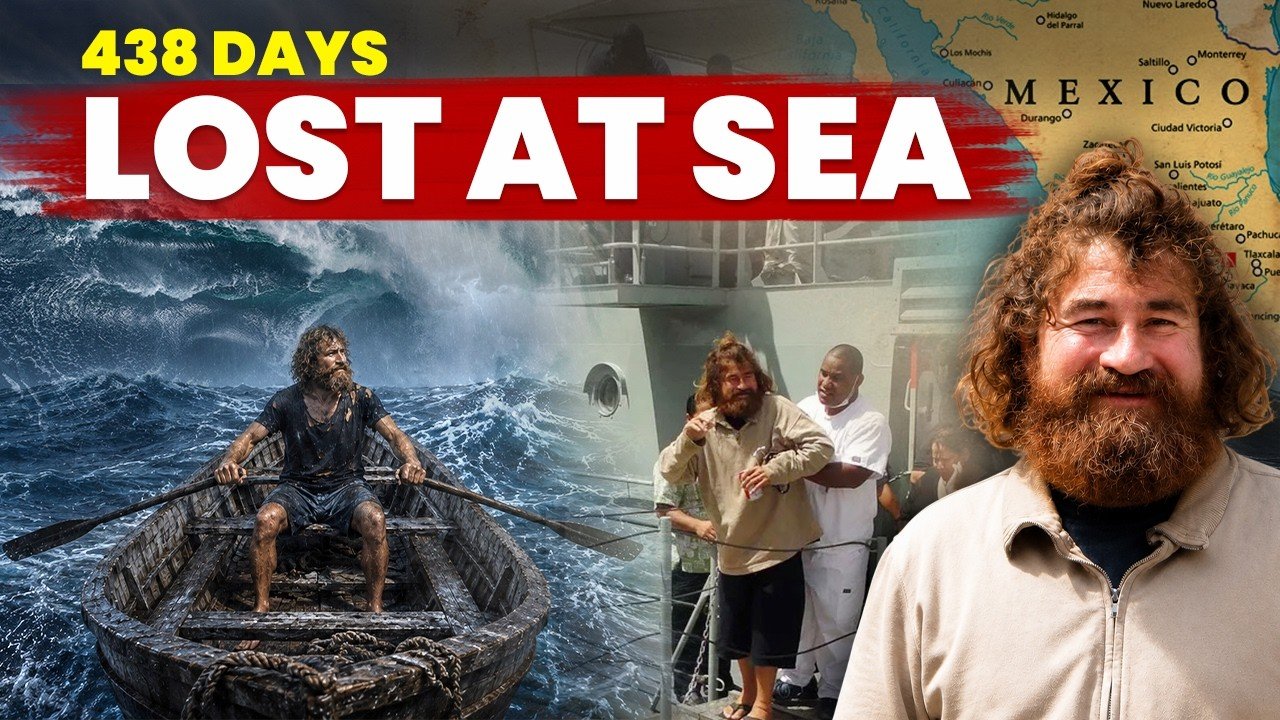

It was the morning of 17 November 2012 in Costa Azul, a small coastal fishing village in Mexico’s Chiapas state. The first golden rays of sun were glinting off the deep blue Pacific, and the village was already busy with its daily routine. Some men were repairing their boats, others were getting nets ready to head out, while a few were taking freshly caught fish to sell at the market.
Amid all this, 36-year-old José Salvador Alvarenga was also preparing his boat. But Alvarenga wasn’t just any fisherman. He was a master of the sea. Originally from El Salvador, he’d spent years fishing these dangerous Mexican waters. From a young age, he’d made the ocean his companion, earning a reputation as the kind of expert who would head out even when everyone else, terrified by the hint of a storm, wouldn’t dare go near the shore.
That 17th of November, Alvarenga set off with the same confidence, aiming to haul in hundreds of kilos of fish. Usually, his trusted partner Ray Pérez went with him. But at the last moment Ray refused. So Alvarenga asked 22 year old Ezequiel Córdoba to come along instead. Córdoba was new to the job, but he was physically strong and could work ten to twelve hours straight.
Alvarenga tempted him with a bit of extra money, and Córdoba agreed. They loaded the essentials onto their boat and left the Costa Azul coast behind. The trip normally lasted around thirty hours, and for Alvarenga it was nothing unusual. But this time he had no idea that the sea he’d always called a friend was waiting for him in its most terrifying form.
In the next few hours, their lives were about to change in ways they could never have imagined. This marks the beginning of what would become known as the greatest survival story ever recorded, a thrilling survival story that would captivate the world.
The Storm That Changed Everything
Once out at sea, Alvarenga pushed his 25-foot boat hard into the Pacific. After many hours, they were roughly seventy-five miles from shore, the kind of spot where you could catch fish in abundance. They chose the right place and cast their net, and before long heavy fish began to thrash inside it. Within just a few hours, the two of them had caught more than 500 kilograms of fish, and their faces lit up with joy.
By then the sun was sinking, and the sky had turned a deep reddish hue. But in the stillness of the open sea, Alvarenga and Córdoba wanted more, and for that, they would have to spend the night out there in deep water. So under the stars, rocking on the waves, they ate, fished, and joked with each other. It was so beautiful it could have felt like a dream.
And then the dream shattered. Around one in the morning, everything changed. The wind began to howl. The sky filled with black clouds, and the waves grew faster and taller. Before either of them could fully understand what was happening, a violent storm closed in around their boat. The wind lashed at them, and water started pouring in with every towering wave.
Without wasting a second, Alvarenga fought the pounding surf and tried to drive the boat back towards land. But within moments the weather turned even more brutal, and the situation worsened. As the boat filled rapidly, Córdoba kept bailing water out again and again. He was so terrified he was crying, screaming for help. Somehow, they survived that horrific night. This thrilling survival story was only just beginning to reveal its true horror.
After hours of struggle, at around nine in the morning, the thick blanket of cloud began to thin, and Alvarenga spotted a faint mountain on the horizon. He thought they couldn’t be far from land, that they’d soon be home. But fate had other plans. Just as they were only about two hours from the shore, the engine suddenly died. Its final rattling cough sounded like a funeral bell.
Desperate, Alvarenga radioed his boss, Willie, saying the engine was completely ruined. Their GPS wasn’t working either, and they didn’t even have an anchor on board. He had barely managed to send the message when the weather turned again, and the storm hit them like a starving beast.
Alvarenga quickly realised the 500 kilos of fish on board were throwing the boat off balance. With that much weight, the boat could sink in a storm like this. So he made a brutal decision. Together with Córdoba, he threw every fish they’d spent the whole day catching back into the sea. After that, to lighten the boat even more, they dumped their ice and spare petrol into the water too.
With the engine dead and waves rising like mountains, the boat could capsize at any moment. So Alvarenga improvised. He tied fifty plastic containers to a rope and threw them overboard. It worked like a makeshift sea anchor, holding the boat back, at least a little, from being dragged to its death. But while they fought nature with everything they had, their luck showed them no mercy.
By ten in the morning, the radio battery died, and with it, their last connection to the outside world. Now no one knew where they were, and they had no way left to call for help. They were completely alone in the vast Pacific Ocean. This insider story of being lost at sea for 438 days would become the most extraordinary true story of survival at sea ever documented.
The Long Drift Begins
Just how serious their situation was can be understood from one fact. Around 71 percent of Earth’s surface is covered by water, and the largest share of that water is the Pacific, so immense it’s bigger than all the world’s land put together. Where they were, there was nothing but endless, raging sea in every direction, lightning overhead, weather changing by the minute, and the fear of death growing with every passing moment.
They were so lost that Alvarenga’s boss Willie sent out search parties for two days, but there was no sign of them. And this chilling story of Alvarenga and Córdoba was only just beginning. What lay ahead was so horrific that even death would start to seem like the easier option.
For days on end, the storm batters them mercilessly, and they fight nonstop just to stay alive. Nearly five days pass like this, and only on the sixth day does the storm finally ease. But in that time they’ve been dragged hundreds of kilometres out to sea, with no idea where they are. In this vast ocean stretching tens of thousands of kilometres, they’re no bigger than the tip of a needle. Surviving the brutal conditions is incredibly hard.
In the daytime, the sun. At night, biting cold. To protect themselves, they flip an ice box, about the size of a fridge, upside down and hide inside it. When it gets freezing, they cling to each other, wrapping their legs together to conserve body heat. But whenever seawater floods the boat and threatens to sink it, they have to scramble out of the ice box and bail the water out.
By now, hunger and thirst have left them in a terrible state. Water is everywhere, but drinking salty seawater would only make things worse. They’re desperate for rain. When it doesn’t come for days, a helpless Alvarenga begins drinking his own urine. His companion, Córdoba, is horrified, but to stay alive, at Alvarenga’s insistence, he does the same.
Their fishing hooks were lost in the storm, so finding food becomes another battle. Alvarenga comes up with a different method. He kneels at the edge of the boat, plunges his hands into the sea, and whenever a fish brushes against him, he grabs it and flings it into the boat.
Sometimes seabirds land on a pole fixed to their boat, and they lie in wait and catch them too. Occasionally they manage to catch turtles and drink their blood. Taste no longer matters. Survival is all that’s left. This thrilling survival story demonstrates the extreme lengths humans will go to stay alive.
Weeks Turn Into Months
Weeks drift by, but there’s still no sign of land. One day, as they rest inside the ice box, they hear a sound. They climb out and can hardly believe their luck. Dark clouds have gathered, and heavy rain is pouring down. For two men who’ve been drinking urine for weeks and are on the verge of dying of thirst, this storm feels like a blessing.
They stand with their mouths open, drinking the rain drop by drop. The fresh water is like life flooding back into them. They strip off their clothes and bathe in the rain, and they collect water in their bucket too. That relief buys them a little time, but each day in the endless swells of the Pacific brings a new trial. Days turn into weeks, weeks into months, and their condition grows more horrific.
Nearly two months have passed, and they’ve begun to accept that no one is coming, that the world has forgotten them. They’re now thousands of kilometres from shore, in waters where passenger ships never pass, only the occasional container ship.
One day, as they sit there, wilted and exhausted, they spot a cargo ship in the distance. In that instant, it’s as if life returns to them. Hope flashes in their eyes. Without wasting a second, they tie a shirt to the end of a stick and set it alight. Alvarenga waves it with all his strength, praying someone on board will see the signal and turn towards them. But the ocean is too vast, and their hope too small. The ship keeps going, as if it saw nothing.
Alvarenga refuses to give up. This time he uses a small mirror he has with him, catching the sun at the right angle and repeatedly flashing reflections as a signal. But nothing changes. Before long, the cargo ship, hope made visible just moments ago, slowly disappears, and once again they are utterly alone in the ruthless, endless Pacific.
Alvarenga, raised among the sea’s blows since childhood, doesn’t surrender. But for 22-year-old Córdoba, it’s like a nightmare. He’s broken, not only physically, but mentally too. Every moment he’s haunted by thoughts of his mother and his village football team. This greatest survival story shows how the human spirit can endure even when all hope seems lost.
The Poison That Nearly Killed Córdoba
One day, seeing the full moon, they guess that Christmas has arrived. They decide they’ll celebrate and eat birds for Christmas dinner. Alvarenga quickly catches two seabirds and prepares the meat. But as soon as they start eating, Córdoba begins vomiting. Within moments, foam appears at his mouth. Alvarenga can’t understand what’s happening.
He thinks the food has made him ill. So he cuts open the dead bird’s stomach, and his blood runs cold. Inside is a small, poisonous yellow snake the bird had swallowed. Its venom has already spread through Córdoba’s body.
For days, Alvarenga watches him fight for his life, and somehow Córdoba survives. But the incident fills him with such terror that even the thought of food now frightens him. He almost stops eating altogether, and his body becomes a skeleton from starvation.
As time passes, Córdoba’s will collapses completely. He closes his eyes and waits for death. His voice dwindles to a weak whisper. He often tells Alvarenga he can’t endure any more. In the silence of night, when waves strike the boat, Córdoba’s sobs tear through Alvarenga’s heart.
Córdoba begins to suffer hallucinations. Sometimes he believes his mother is calling him, waiting for him on the shore. When he comes back to himself, he cries and asks Alvarenga for one final promise. If you survive, go to Mexico, meet my mother, and tell her her son remembered her until his last breath. Tell her I loved her, and I’m sorry I couldn’t say goodbye.
One day the sun burns as mercilessly as ever, but inside the boat there’s a cold stillness. Córdoba takes one last long breath, his eyes fixed on the sky, as if he can see his mother’s face beyond the clouds. He gently squeezes Alvarenga’s hand, as though trying to speak, and then his body goes slack. Alvarenga shakes him, screams, but Córdoba is dead.
Córdoba’s death hits Alvarenga like a blow. He blames himself because he was the one who brought Córdoba on this trip. He curses himself too, asking why Córdoba died instead of him. The loss pushes him into such darkness that he begins playing a dangerous game. He refuses to accept that his companion is gone. He props the body at the front of the boat so the waves won’t carry it away. When the sun rises the next morning, Alvarenga starts talking to the lifeless body.
For hours he speaks to it, asking about breakfast, commenting on the weather, offering encouragement, sharing plans, and then he answers himself, pretending to be Córdoba. For nearly six days, it continues. But one night, mid-conversation, it’s as if he suddenly wakes up. He realises he’s been talking to a rotting corpse for days. He understands that if he stays with it any longer, he’ll lose his mind completely.
Before dying, Córdoba had made him promise he would not eat his body, and Alvarenga doesn’t even consider it. One day, with a heavy heart, he pushes Córdoba’s body into the water. It sinks slowly into the depths of the Pacific, leaving behind a man now completely alone in an endless blue sea. This thrilling survival story reaches its darkest chapter yet.
Alone With Only Birds for Company
From here on, Alvarenga must face the ocean’s cruelty alone, without even a voice to speak to. Each passing day feels like a year, and months go by with him stranded in the middle of the sea. Crushed by hunger, thirst, and loneliness, he tries to take his own life four times. But each time, some stubborn spark of hope stops him.
Anyone could go mad after months like this. So, to protect his sanity, Alvarenga begins forming a bond with the seabirds that fly overhead. During this time he notices one bird that seems different from the rest. It isn’t afraid of him, and it doesn’t seem in a hurry to fly away. Alvarenga decides to keep it, placing it inside his little ice box shelter.
He names it Pancho. He feeds it fish and talks for hours about his home, his daughter, and his old life. Pancho’s presence makes him feel he has to return alive from this vast Pacific.[
But after many days, a time comes when Alvarenga has not a single bite left to eat. He goes days without food, and sometimes the hunger becomes so unbearable that he chews his own fingernails and swallows the tiny pieces. It does nothing. His body begins to fail. Then his eyes fall on his dear friend Pancho. He thinks, if I don’t eat this bird, I’ll die like Córdoba. Hunger overwhelms his humanity. Survival instinct takes over.
With trembling hands, he strangles his pet bird, kills it, and eats it. The food gives him energy, but now he is once again the loneliest man in the world, with not even a bird left to talk to. With no one beside him, Alvarenga builds a dream world to survive. He closes his eyes and imagines walking through the lanes of his village.
In his mind, he feasts with friends and family, laughing and joking. He trains his brain so well that even those imaginary meals feel real. He does it so he won’t think about death. His will to live burns so fiercely that he endures more than four hundred days alone at sea. His beard and hair grow long. The sun darkens his skin. Boils erupt across his body. Yet his courage still doesn’t break. This greatest survival story continues to astound all who hear it.
Land At Last
So much time has passed, and still there’s no ray of hope. At one point, he begins to believe there will be no miracle, and his next destination is simply death. Just as his strength starts to give out, one day he hears the calls of shore birds, birds that live near land. He can’t believe his ears. He thinks there can’t be any coast here, that it must be another hallucination.
But soon he sees something on the horizon, a hill-like shape, covered with trees and plants. He rubs his eyes again and again, trying to be sure it isn’t a dream. This time he isn’t wrong. This time, he really has reached land. He immediately tries to steer the boat towards the shore, but as he gets closer, a surge of waves keeps changing the boat’s direction. He’s terrified that if he misses this chance, he’ll be dragged back out to sea.
Without wasting a moment, he jumps from the boat and swims with all his strength. A huge wave rises, scoops him up, and hurls him through the air, slamming him onto the dry sand of the shore.[
It is a tiny island called Tile Island, part of Ebon Atoll. Alvarenga lands face down on the sand. For him, that moment is nothing less than rebirth. His horrific journey finally ends on 30 January 2014, after 438 days, during which he has covered around 6,700 miles, nearly 10,000 kilometres. Call it coincidence or sheer luck. If Alvarenga’s boat had missed Ebon Atoll by even a little, he might not have seen land for another 3,000 miles, and then his death would have been certain.
On the shore, with trembling fingers, he grabs a fistful of sand as if it were the most precious treasure on earth. He is completely naked, and his body looks like a skeleton. Organs, bones, and skin- that’s all that remains. He tries to stand, but his legs give way. Crawling across the ground, Alvarenga reaches the dense trees and spots a small hut in the distance, where a couple, Amy Libok Mehta and her husband, Russel Lydick, live.
When they see him crawling towards them, they freeze in fear. They think some creature has emerged from the sea. Alvarenga tries to speak in broken Spanish, repeatedly pointing to his stomach. They immediately realise this man has survived some terrible disaster. When Amy and Russel give him food and water, Alvarenga devours it. He keeps talking as he eats, because after so many months, he has finally found human beings he can speak to. His voice carries relief, panic, and the buried pain he endured alone for so long.
After Amy and Russel alert the authorities, officials arrive and are stunned by his condition. He is taken at once for treatment to the hospital in the capital, Majuro. This thrilling survival story had finally reached its miraculous conclusion.
The Controversy That Followed
When the world hears his story, many assume it must be fake news, because surviving such a long journey in a small open boat seems practically impossible. But Alvarenga had, unknowingly, set a survival world record so extreme that most people wouldn’t even dare imagine it. His courage and stubborn will turn him into a global celebrity overnight.
Because Córdoba had made him promise that if he survived, he would meet his mother, Alvarenga goes to Córdoba’s home, meets her, and tells her the full truth about his companion’s final days. Nothing inside Alvarenga is the same anymore. He can’t sleep alone at night. He keeps the light on, afraid of being alone again.
Yet his extraordinary story inspires the world so deeply that a book is written about his life, 438 Days: An Extraordinary True Story of Survival at Sea, and it soon becomes a bestseller. It brings him both fame and money.
But it also sparks a new controversy. Córdoba’s family files a million-dollar lawsuit, accusing Alvarenga of killing and eating their son to survive. To prove his innocence, Alvarenga even takes a lie detector test and is found completely truthful. According to multiple sources, the family of Córdoba sued Alvarenga for one million dollars shortly after the release of the book, accusing him of cannibalizing their relative to survive, despite Alvarenga sharing that he promised Córdoba he would not eat him.
Alvarenga denies the allegations that he had eaten his former crewmate and friend. Legal experts note it will be difficult for Córdoba’s family to prove their case, as the only witness to Córdoba’s death was Alvarenga himself. This insider story of being lost at sea for 438 days continues to generate debate and fascination around the world.
Why This Story Matters
Alvarenga’s 438-day journey isn’t just a survival story. It’s a testament to human willpower, showing that if a person truly decides to live, they can defeat even death. This thrilling survival story has become one of the most documented and studied cases of extreme human endurance in modern history.
Jonathan Franklin, the investigative journalist who wrote the book, didn’t just take Alvarenga’s word for it. He dug into satellite data, weather reports, and even consulted other castaways to validate the story. The book has been praised for its thorough research and compelling narrative, though some critics note the limitation of having only one primary source for such an extraordinary tale.
Additional facts about this greatest survival story include that Alvarenga survived mainly on a diet of raw fish, turtles, small birds, sharks, and rainwater. He drifted without navigation, sail, rowing, or paddling, purely at the mercy of ocean currents and winds. He created makeshift tools from available materials, including fashioning a fish hook from an engine part and sewing moccasins from shark skin.
After his rescue, Alvarenga faced physical and psychological sequelae, and his current whereabouts are not publicly known. The journey covered approximately 10,700 kilometres across the Pacific Ocean, from Mexico to the Marshall Islands. This thrilling survival story continues to inspire people around the world with its message of hope, resilience, and the indomitable human spirit.