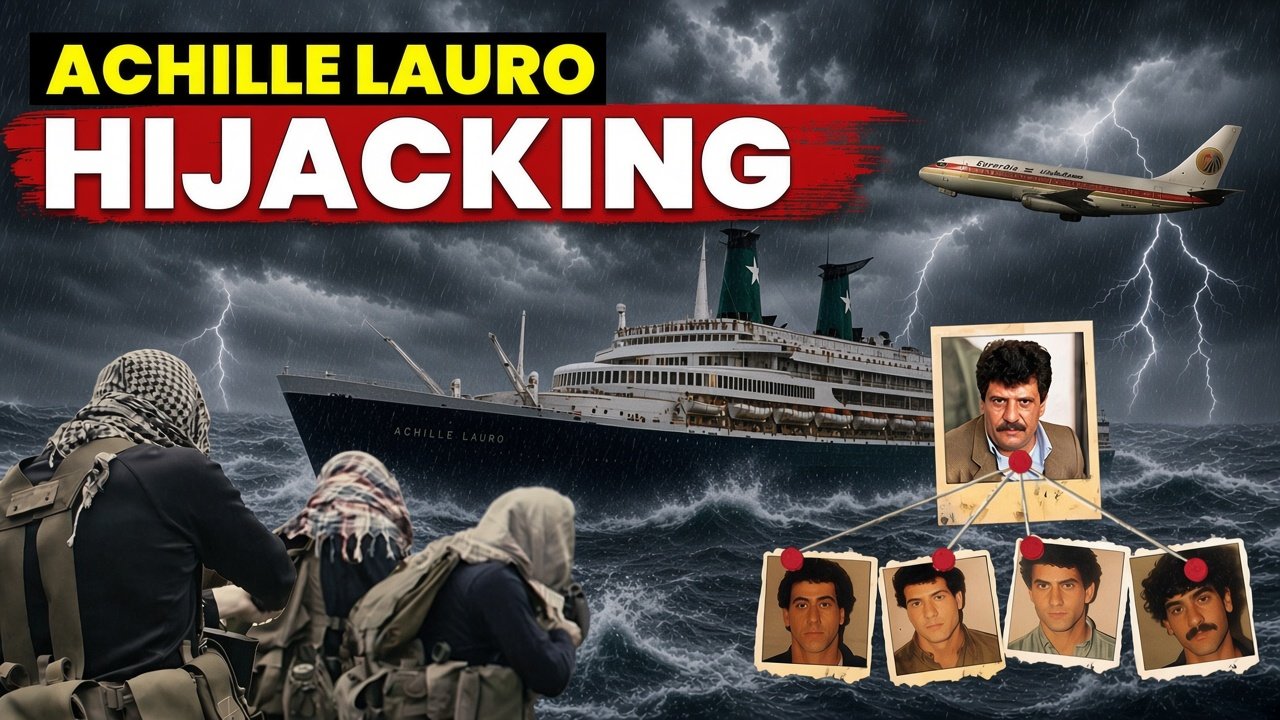

On 3 October 1985, the Italian cruise ship Achille Lauro set sail from Genoa with 748 passengers and 320 crew members on board. It was meant to be an eleven-day voyage, calling at Alexandria in Egypt and ending at the port of Ashdod in Israel. Captain Gerardo de Rosa was in command, and Max Fico managed the ship’s daily running.
Most of the passengers were Americans and Britons, along with a smaller number of Italians, Germans and Austrians. Nearly everyone had come to relax with their families, and many had planned to leave the ship at Alexandria after four days and take a bus to see the Pyramids of Giza.
Among the passengers was a group from New York and New Jersey who had given up their usual holidays on the Jersey Shore for a bit of adventure. Nobody on board had more riding on this trip than Leon Klinghoffer, a 69-year-old Jewish American businessman. He had planned the cruise as a gift for his wife Marilyn’s 58th birthday.
The last few years had been hard on them. Marilyn had recently beaten colon cancer, and Leon had survived two strokes and now spent most of his time in a wheelchair. This trip was supposed to be a celebration of having come through all of that.
The sea was calm, and the golden evening light broke into pieces on the waves as the ship moved forward like a single star in a wide dark sky. On 4 October, the Achille Lauro reached Naples and then entered the Strait of Messina. On deck, children laughed and ran about, older passengers sat in the sun, and others took photos of each other. Everyone was looking forward to the days still ahead.
But four men on board had not come to enjoy the voyage. They had come with a terrible purpose. They kept away from the other passengers, and when asked, they said they were Norwegian, though they could barely follow fluent English. Max Fico noticed that their behaviour was odd, but the ship was crowded, and nobody paid much attention.
The Achille Lauro sailed on, and after about three days it entered the Mediterranean on 6 October. That day was Marilyn’s birthday. A cake was cut, people clapped and sang, and the whole ship felt warmer for it. No one could have guessed that within hours something would happen that would change the lives of the passengers and the relations between several countries for good.
On the morning of 7 October, the ship docked at Alexandria. There, 651 passengers left for their trip to the Pyramids, planning to rejoin the ship fourteen hours later at Port Said. That left only 97 passengers on board besides the crew, including Leon Klinghoffer, his wife and their friends. After a short break, Captain de Rosa turned the ship toward Port Said, about 225 kilometres to the west.
While the ship was on its way, a cabin warden was going from room to room delivering complimentary food to the remaining passengers. He came to the cabin of the four strange men, and the door happened to be open. What he saw made him freeze. The four men were cleaning weapons. In those days, security on cruise ships was very basic, and the men had smuggled their guns onto the ship by hiding them in the oil tank of their car, which they had driven to the Italian port.
They had not meant to act yet, because their plan still needed more time. But now they had been seen, and in a panic they pointed a gun at the warden and took him hostage.
The four then walked out of the cabin and into the dining hall and opened fire with their automatic weapons. The calm, peaceful atmosphere turned to chaos in seconds. People screamed and ran in every direction, but there was nowhere to go. They were in the middle of the sea, on a ship only a few hundred metres long. Fear and silence settled over everyone.
Before the hijackers could reach the radio room, a radio operator managed to send out an SOS that the ship had been hijacked. A radio station in Sweden picked it up. The hijackers had no idea. A few minutes later they smashed the ship’s entire communication system. Then they took Captain de Rosa hostage at gunpoint and ordered him to turn the ship toward the Syrian port of Tartus. They warned him that there were not four of them but twenty, and that at the first sign of trickery they would shoot everyone. In truth, there were only four. The claim of twenty was just meant to spread fear.
Meanwhile, the passengers who had gone on the tour returned to Port Said that evening, and were surprised to find no sign of the Achille Lauro. At first they were told that the ship was delayed by traffic in the Suez Canal. After three more hours of waiting, the truth came out: the ship had been hijacked.
The big questions now were who these four men were, why they had hijacked the ship, what they would do to the hostages, and how this one event would pit so many nations against each other.
With the captain forced to obey, the hijackers began separating the hostages by nationality. They were specifically looking for Jews, Americans, and Britons. These passengers were gathered and taken to the upper deck, while the Italians, Germans, and Austrians were kept on the lower deck. Although Leon Klinghoffer was both Jewish and American, the hijackers left him in his cabin below because his wheelchair made it too hard to carry him upstairs. But Marilyn was locked up with the other hostages on the upper deck.
Once the hijackers felt the situation was under control, they made their demand. Israel must free 50 Palestinian prisoners from its jails, or there would be terrible consequences. They set a deadline of 3 p.m., warning that if the prisoners were not released by then, they would start killing hostages.
The situation was extremely serious because so many countries were now involved. The ship was Italian; many of its passengers were American and British, the hijacking had happened off Egypt, and the hijackers claimed to belong to the Palestine Liberation Front, demanding that Israel free prisoners while steering toward Syria. In one single incident, Italy, Egypt, the United States, Britain, Israel, Palestine, and Syria were all directly caught up. I
taly and Egypt wanted to settle the matter quietly through diplomatic talks. The United States branded the hijackers terrorists and wanted to show no mercy. Israel, for its part, took a hard line and flatly refused to release any prisoners.
By the afternoon of 8 October, Israel’s answer was still clear: not one prisoner would be freed. The hijackers were furious, and they began discussing which passenger to kill first. After some thought, they chose Leon Klinghoffer. He was Jewish and an American citizen, and because he was in a wheelchair and could hardly move or defend himself, he was the easiest to kill. By killing him, they hoped to hurt both America and Israel.
They dragged him, wheelchair and all, to the stern of the ship and shot him in the head and chest. He died instantly. Then they threw his body, still in the wheelchair, into the sea. Many passengers heard the gunshots, followed by the splash of something heavy falling into the water, and trembled with fear. A little later, one of the hijackers returned to the bridge, his clothes stained with blood. He told Captain de Rosa that he had killed an American, and that if their demands were not met quickly, a British passenger would be next.
By now the ship was very close to the Syrian port of Tartus, and the hijackers had the captain ask Syrian authorities for permission to dock. The answer came back: go back where you came from. Syria did not want a confrontation with the United States, which had already warned every country on the Mediterranean coast not to let the Achille Lauro dock in its ports. With Syria refusing, the hijackers ordered the captain to head for Libya. Time was running out, and with every passing minute the passengers’ lives hung by a thinner thread.
Since the hijackers had demanded the release of 50 Palestinian prisoners, the American and Italian governments contacted Yasser Arafat, chairman of the Palestine Liberation Organization, to find out whether the PLO had any part in this. Arafat condemned the hijacking at once and denied any involvement. He said he would do everything possible to help resolve it peacefully, and he sent two of his associates, Abu Abbas and Hani al-Hassan, to Egypt as negotiators, telling them to reach the hijackers and settle the matter.
Abu Abbas was the head of the Palestine Liberation Front, a faction within the PLO. Through a radio station in Cyprus, he contacted the hijackers and told them to return to port and treat the passengers well. Captain de Rosa and Max Fico, who were on the bridge, heard the conversation, and Abbas even apologised to them on the hijackers’ behalf. Here is the interesting part. The real mastermind of the hijacking was Abu Abbas himself, the man now playing the negotiator. He is said to have planned it in such secrecy that even Arafat did not know.
In fact, hijacking the ship had never been the goal. Abbas wanted to get his men on board so they could reach the ship’s final destination, the Israeli port of Ashdod. There they planned to attack an Israeli military base, in revenge for Israel’s attack on Tunisia. But the cabin warden saw the weapons before the plan could unfold, and the men were forced to seize the ship in the middle of the sea.
Now, with so many countries involved, Arafat was under heavy pressure. Abbas realised that negotiation was the best way out, since it would keep his own role hidden. On his orders, the hijackers agreed to a deal, and at about seven on the evening of 8 October the ship was turned back toward Port Said.
The conversation between the hijackers, Captain de Rosa and Abu Abbas was intercepted by Mossad, the Israeli intelligence agency, which sent the recording to the United States. This told America that Abu Abbas was the real brain behind the hijacking, and Washington became eager for a military rescue mission.
Meanwhile, Egypt and Italy were preparing to negotiate with the hijackers through Abu Abbas and Hani al-Hassan. At 7:30 on the morning of 9 October, the Achille Lauro arrived at Port Said. Soon after, Abu Abbas and Hani al-Hassan arrived as well and began talks on behalf of Egypt and Italy, making the whole thing look like a serious official negotiation. That afternoon Yasser Arafat spoke to the Italian Prime Minister, Bettino Craxi, and said the hijackers were ready to release all the hostages.
In return, they wanted safe passage, and they asked that officials from Italy, Britain, the United States and West Germany come to Port Said to talk with them.
The Italian ambassador, Giovanni Migliuolo, asked the other ambassadors to go to Port Said. The American ambassador, Nicholas Veliotes, refused, saying it would give the hijackers a sense of victory and that America’s policy was never to negotiate with terrorists.
In the middle of all this, a message came from the ship’s captain: “This is the captain of the Achille Lauro, and all my crew and passengers are safe.” In reality, one of the hijackers had forced Captain de Rosa to say it at gunpoint, so that every country would hear that everyone was safe and agree to grant the hijackers safe passage.
Using this message, Egypt’s foreign minister met the four ambassadors again and pressed them to hand the hijackers over to the PLO rather than arrest them. The American and British ambassadors strongly objected, but Egypt, together with the Italian and West German ambassadors, agreed to the deal. Despite America’s opposition, the Egyptian government began arranging the hijackers’ safe exit.
At 5 p.m., the four Palestinian hijackers were taken ashore on a boat. As they reached safety inside Egypt, local people greeted them with loud cries of “Fedayeen! Fedayeen! Allahu Akbar!”
Three days after it had begun, the Achille Lauro was finally free of the hijackers, and the passengers breathed a sigh of relief. But when Marilyn Klinghoffer learned from Captain de Rosa that her husband Leon had been shot and thrown into the sea, she broke down sobbing and collapsed in shock.
Soon the news reached America that one of its citizens had been killed by the hijackers, and the country’s anger reached boiling point. Washington immediately pressed Egypt to hand over the hijackers so they could be tried in the United States. Italy also wanted them punished, and argued that since the ship was Italian and the murder took place on it, the hijackers should be tried in Italy.
Egypt now found itself stuck in the middle. President Hosni Mubarak did not want to hand the hijackers to America or Italy and lose support in the Arab world, but he also could not afford to lose the billions of dollars in aid Egypt received from the United States.
So he decided to get the hijackers out of Egypt as quickly as possible and wash his hands of the matter. He put out a statement that the ship was Italian, that there had been no Egyptian passengers, that the hijackers were not Egyptian, and that the incident had happened outside Egyptian waters, so Egypt had no legal basis to hold them.
In secret, Egypt gave the PLO 48 hours to take the hijackers to a safe country. Publicly, it spread a false story through the media that the hijackers had already left Egypt. But US intelligence knew they were still there, and America decided to catch them on the way. Both the United States and Israel worked to track the hijackers in hiding.
On the morning of 10 October 1985, Israeli military attaché Major General Uri Simhoni told American security official Oliver North that the hijackers were at the Almaza air base near Cairo. A few hours later, the US learned that Egypt planned to fly them to Tunisia that night on an EgyptAir Boeing 737. Since Egypt’s relations with Libya and Chad were poor, the Americans expected the plane to fly over the Mediterranean, where US Navy fighter jets could easily intercept it.
The mission was handed to a US Navy officer, James Service, who began planning right away. He drew on the example from World War II, when the US intercepted the plane of the Japanese Admiral Yamamoto. This time the difference would be that instead of shooting the aircraft down, the US would force it to land.
The place chosen for the forced landing was Sigonella in Italy. The base was under Italian military control, but it also housed a US Navy air station, so it was on Italian soil yet still somewhere America could operate. The plan was soon approved by President Ronald Reagan.
At 4:15 on the night of 10 October, the EgyptAir Boeing 737 took off with the hijackers on board, along with Abu Abbas, Ozzuddin Badrakhan and commandos from Egypt’s elite Force 777. It looked as though Egypt were escorting them safely under official security. The plane was headed for Tunisia, where the PLF had its headquarters.
On the other side, American F-14 Tomcat fighters, an E-2C Hawkeye radar aircraft, A-6 Intruders and EA-6B electronic warfare planes began to shadow the Egyptian aircraft. When US officials tried to find it on radar, they saw several aircraft and could not tell which one was the EgyptAir 737. So the F-14 Tomcats switched off their lights and flew very close to each aircraft to identify it visually.
After checking a number of planes, an American pilot named Massey drew up next to one Boeing and switched on his flashlight to read the tail number. When he saw the marking, he could hardly contain his joy. Once it was confirmed, the American aircraft surrounded the EgyptAir 737 from all sides.
Seeing itself boxed in, the Egyptian plane asked Tunisia and Athens for landing clearance, but both refused out of fear of the United States. Then the pilot of the US Hawkeye sent a radio message to the EgyptAir crew: “Divert to Sigonella now.” When the Egyptian pilot did not comply, the American pilots warned that they would shoot him down. The US fighters were now flying so close that the pilot could barely manoeuvre. In the end, he gave in and turned the plane toward Sigonella. After a few hours in the air, at 6:45 in the evening, the EgyptAir 737 landed there.
The moment it landed, US Navy SEALs surrounded it. Then a strange thing happened. Within minutes, the Italian Air Force and the Italian military police, the Carabinieri, surrounded the American forces from behind. So the Egyptian plane was at the mercy of American guns, and the Americans were in turn at the mercy of Italian guns. It looked as if a ship hijacking might push two allied countries toward war. In history, this tense standoff is called the Sigonella Crisis.
The problem was this. The Achille Lauro was an Italian ship, so Italy said the case was its own. The US said an American citizen had been murdered, so it had the first right to punish the hijackers. And above all, the US had forced the Egyptian plane down at Sigonella without informing Italy, which Italy saw as a violation of its sovereignty. About 80 American special forces had surrounded the plane, while more than 300 Italian air force and Carabinieri personnel had surrounded it, with trucks blocking the runway.
The US Department of Defense understood that while they could seize the hijackers, forcing them out of Italy would be an invitation to war. So at 4 a.m. on 11 October, the US ordered its forces to stand down. After about five hours of talks between Italy and America, the two agreed that the hijackers would stay in Italy and be tried there. They were taken off the plane and immediately arrested by the Carabinieri and sent to a police station.
The matter of Abu Abbas was harder. He insisted he was only a negotiator, and Egypt backed him, saying he had diplomatic status. The PLO warned Italy that if it handed Abbas to the US, there would be serious consequences. In the end, the Italian government let Abu Abbas go. He and Badrakhan flew to Rome on an EgyptAir plane and then on to Belgrade on a Yugoslav Airlines flight. The US was angry with both Italy and Yugoslavia, but it had no other option.
Leon Klinghoffer’s body was found several days later, on 15 October, near the Syrian port of Tartus. The incident shook the world and changed the Klinghoffer family’s lives forever. Some years later, Leon’s daughters, together with the Anti-Defamation League, founded the Leon and Marilyn Klinghoffer Memorial Foundation, which works against terrorism through education, politics and legal means. In the Italian courts, when the case was tried, the PLO was ordered to pay $1.5 billion to the Klinghoffer family.
Meanwhile, action was also taken in Italy against the hijackers and the people involved in the planning. On 10 July 1986, the Italian court found the hijackers guilty of hostage-taking with terrorist intent leading to murder. The surprising part is that the court described them as soldiers fighting for their ideals, not as terrorists. Youssef al-Molqi, who had shot Leon Klinghoffer, was sentenced to 30 years.
Ibrahim Fatayer Abdelatif received 24 years, Bassam al-Ashker 16 years, and Ahmad Marrouf al-Assadi 15 years. The real mastermind, Abu Abbas, was sentenced in absentia to life imprisonment, but he never served it because Italy had already let him go, and he kept running from one country to another. Later, in 2003, during the Iraq War, US special forces raided a safe house south of Baghdad and captured Abu Abbas. In 2004, he died in American custody.
After the hijacking, the Achille Lauro went back to work as a cruise ship for a while. But on 30 November 1994, it caught fire off the coast of Somalia. All the passengers were rescued, but the fire could not be brought under control, and on 2 December 1994 the ship sank.
The Achille Lauro hijacking showed that sometimes a hijacking is not just about one ship. It can shake global politics and set countries against each other. The event reminds the world that terrorism is not one country’s problem but a threat to everyone, and that if the world does not face it together, even a small incident can push many nations to the edge of war.