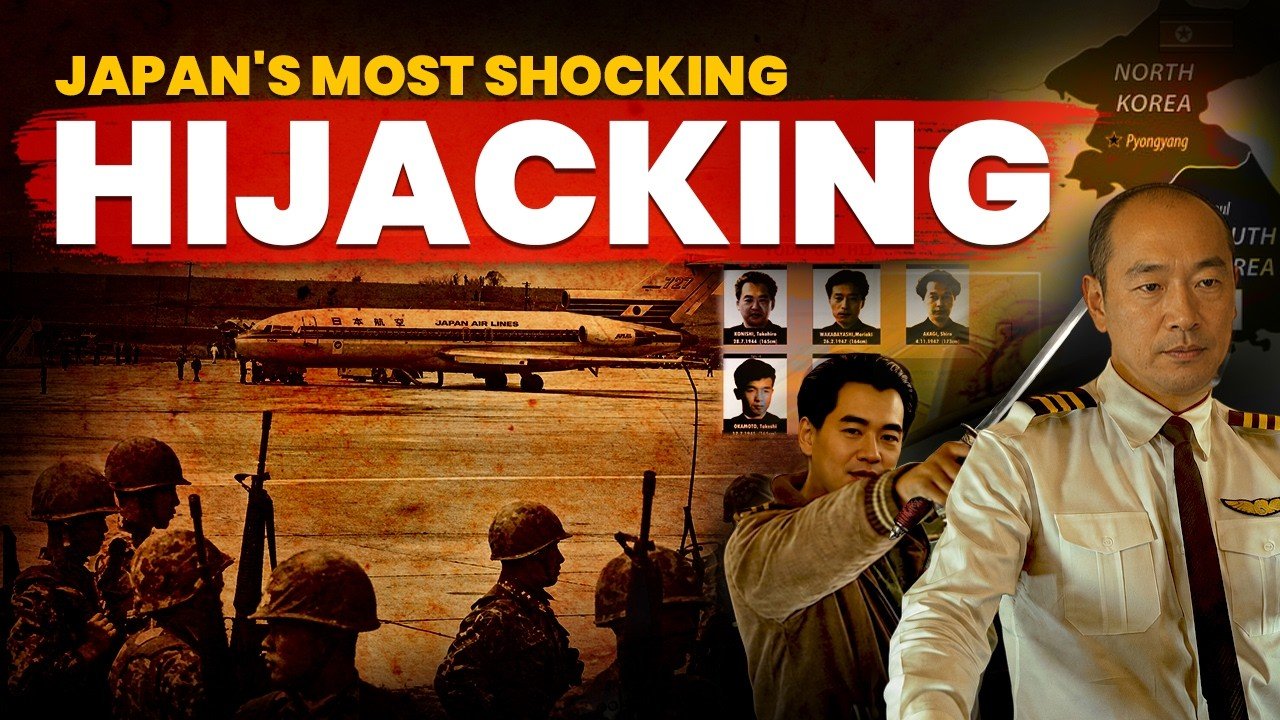

On the morning of 31 March 1970, Tokyo Haneda Airport was busy as usual. Planes were landing, others were lining up to leave, and nobody on the ground suspected that one of them would soon become part of the most talked-about plane hijacking in Japanese aviation history.
Japan Airlines Flight 351, a Boeing 727, was bound for Fukuoka with 122 passengers and seven crew, so 129 people in total. There were tourists, businesspeople, students, and doctors. A few names were known too, including a senior Pepsi executive in Japan, Herbert Brill, and a Catholic priest from New York, Father Daniel McDonald. Captain Shinji Ishida was in command. At 7:33 a.m., the aircraft rose into the sky, and the cabin settled into the calm of any ordinary domestic flight.
I have read many Plane Crash true stories over the years, and what keeps pulling me back to this one is how ordinary the start was. There was no warning and no tension. People read newspapers and looked at the clouds while the cabin crew prepared the trolleys. Then the plane passed Mount Fuji.
Nine Men Stand Up
A 27-year-old man named Takamaru Tamiya suddenly rose from his seat, walked into the middle of the cabin, and drew a long sword. Some passengers assumed he was simply unwell. They thought one man with a sword could not do much against a full cabin.
Then eight more people stood up from different rows. They carried a pistol, an axe, pipe bombs and handguns. Tamiya announced that the plane had been taken over and that anyone who tried to be clever would be blown up in mid-air. Panic spread. The hijackers tied male passengers to their seats with rope so no one could interfere, and then stormed the cockpit. A pistol was pressed against the captain, and he was ordered to fly to Cuba.
This is what makes this airplane hijacking so unusual. The attackers were not trained terrorists. They were university students, and the youngest was only 16. One of them, Moriaki Wakabayashi, even played bass in the well-known rock band Les Rallizes Denudes.
Why Students Chose Plane Hijacking
To understand the reason behind this plane hijacking, you have to understand Japan in the 1960s and 1970s. After the Second World War, Japan was under the control of the Allied powers, mainly America, and American military bases remained on Japanese soil. Anger grew, especially among young people. Many believed their government was a puppet of Washington, and university campuses turned into protest battlegrounds.
Out of this climate came the Red Army Faction, a radical offshoot of the Communist League. They wanted an armed revolution at home and a communist revolution across the world. Their thinking included something they called the international base theory, which said a revolution in Japan could only survive with a strong base abroad. They picked Cuba, where Fidel Castro stood against America. The idea was to train there, return home, and begin an armed struggle. The original planner, Takaya Shiomi, was arrested just before the mission, but the remaining students went ahead under Tamiya.
A Plan That Ignored Basic Aviation
The first mistake was almost comical. Havana was about 12,000 kilometres away, while the Boeing 727 could fly roughly 4,720 kilometres at a time. When Captain Ishida explained this, the hijackers were stunned. They chose North Korea as a second option, since it was close and openly hostile to America.
Ishida did not want to land in Pyongyang. Japan had no diplomatic ties with North Korea, and getting passengers back would be a nightmare. So he told the hijackers there was not enough fuel and no proper map, and that they must land in Fukuoka first. Tamiya hesitated, then agreed. During the approach, the captain quietly alerted air traffic control about everything.
Fukuoka and a Very Strange Map
Around nine in the morning, the plane touched down at Itazuke Airport. Authorities first considered force, but the hijackers threatened to blow up the aircraft. So the talks began. Fuel and maps would be given only if passengers were released, and at 1:35 p.m. the hijackers freed 23 women, children, elderly, and sick passengers.
The map handed over was a photocopy from a school atlas with a line across the Korean Peninsula and two labels, North Korea and South Korea. Hidden in a corner was a short note telling the crew to monitor 121.5, the emergency frequency, along with instructions for landing in Seoul. Captain Ishida understood at once. For the rest of the flight, he acted as if Pyongyang was the destination.
The Fake Pyongyang
Near the border, two fighter jets appeared and fired at the plane. The passengers thought North Korea was about to shoot them down. In reality, they were South Korean jets, helping the bluff feel real. Then a voice came over the radio saying this was Pyongyang, and the plane was cleared to land.
On the ground, flags flew, soldiers stood in rows, a banner welcomed the visitors, women in traditional dress held flowers and children sang. Japanese authorities, a South Korean agency, and the CIA had turned Gimpo Airport in Seoul into a stage set.
But the details gave it away. Tamiya came down the stairs with his sword and noticed a fuel truck with a Shell logo. Then he saw a Northwest Airlines plane and an African American soldier in the terminal. When he demanded to see a portrait of Kim Il Sung, no one had one. A soldier even answered yes when a hijacker asked in English whether this was Seoul. The perfect trick had collapsed because of a missing picture.
Fifty Hours of Fear
The hijackers ordered an immediate takeoff, but the engines needed an auxiliary starter, and South Korea refused to provide it. More than twenty hours went by. Passengers sat with tied hands, going numb, no power, no air conditioning, little food or water, and a cabin that grew harder to breathe in. Senior officials from both countries gathered at the airport while the world watched.
The hijackers finally warned they would blow the plane up. Then Japan Vice Minister of Transport Shinjiro Yamamura made a decision that stunned everyone. He offered to take the place of the passengers and fly to North Korea himself. After more than fifty hours of deadlock, the hijackers accepted. The passengers walked off the plane, some crying and some embracing, and were flown to Fukuoka on a DC 8.
The Final Flight to North Korea
On the evening of 3 April, seventy-nine hours after the plane hijacking began, Flight 351 took off from Gimpo with thirteen people on board. There were nine hijackers, three crew members, and Yamamura. At 7:20 p.m., they landed at Mirim Airport in North Korea.
When the hijackers handed over their weapons, the world learned something remarkable. The pistols, pipe bombs, swords, and handguns were fake. Only the axe was real. One of the largest plane hijacking cases in history had been carried out with imitation weapons and pure confidence.
What Happened Afterward
Yamamura expected prison but North Korea treated him and the crew harshly without jailing them. After international pressure, they returned safely to Japan. Yamamura became a national hero and later served as Minister of Agriculture, Forestry and Fisheries and as Minister of Transport. In 1992 he was killed by his second daughter, who was struggling with mental illness.
The hijackers were first welcomed as internationalist comrades, but their revolutionary dream faded. They were settled in a special village near Pyongyang and lived under strict rules. Some stayed for life. Some tried to escape, and one, Takeshi Okamoto, was reportedly killed along with his wife while fleeing. Wakabayashi later admitted in an interview that their action was selfish and childish, driven by revolutionary obsession.
Why This Story Still Matters
For anyone interested in Plane Hijacking in Japanese History, Flight 351 is the case to study. It shows how ideology can blind people to basic facts like fuel range, and how calm thinking from a pilot and a bold act from one official can protect nearly a hundred lives. Among all Insider Stories I have written, this one stands out because every part of it sounds too strange to be true, yet it happened. The 2025 South Korean film Good News brought it back to public attention, and it still ranks among the most unforgettable airplane hijacking events ever recorded.