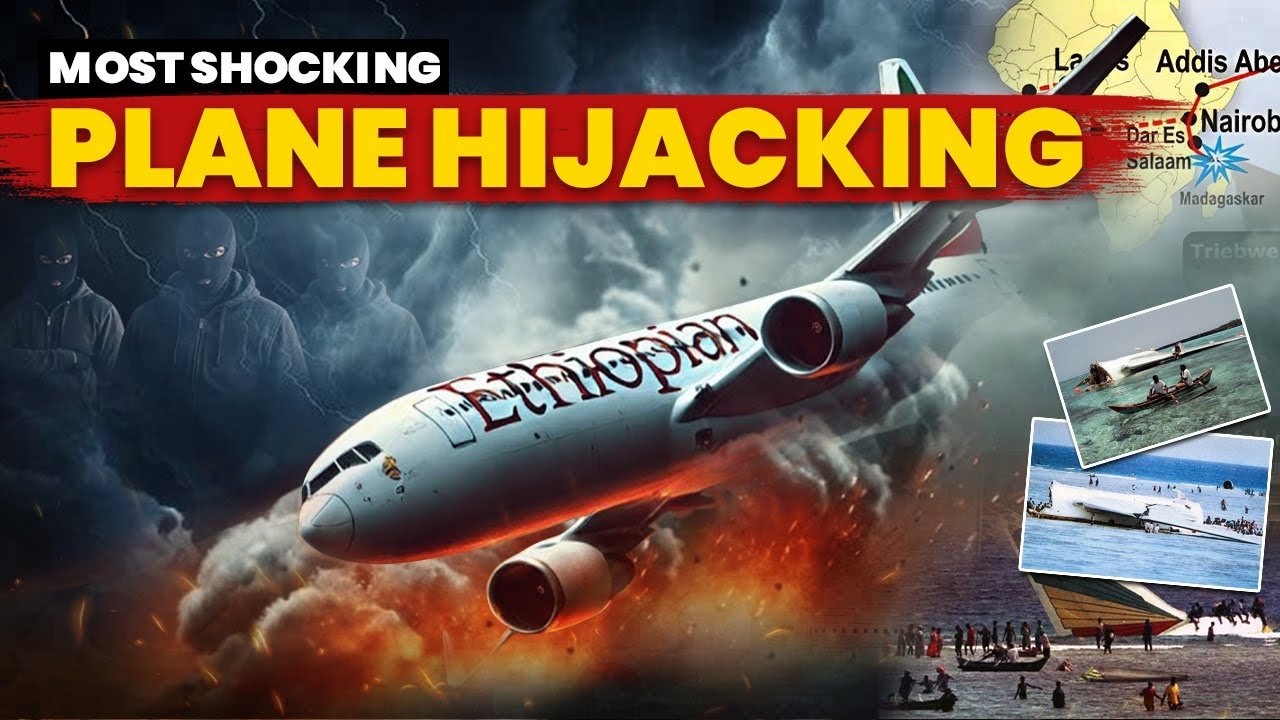

On November 23, 1996, Bole International Airport in Addis Ababa was as busy as ever. At Gate 4, a silver Boeing 767 stood ready for departure. It was nine years old, one of the first wide-body jets in the Ethiopian Airlines fleet, and it still gleamed in the morning sun.
This was Airlines Flight 961, a regional route with several stops: Nairobi, Brazzaville, Lagos, and finally Abidjan. On board were 175 people from 36 countries, including 12 crew members. Captain Leul Abate, a veteran with about 11,500 flying hours, sat in the left seat. Beside him was First Officer Yonas Mekuria, who had more than 6,500 hours of his own.
The plane took off just before 11 a.m. Addis Ababa shrank behind them, and green hills spread out below. Soon the jet leveled off at 39,000 feet. Passengers read magazines, chatted quietly, or watched the landscape through their windows. The flight attendants were preparing the drink service. Nobody could have guessed what was coming.
“I Have a Bomb”
About twenty minutes after takeoff, three men stood up in the cabin. One of them shouted for everyone to stay seated. He said he had a bomb, and that he would blow up the plane if anyone moved.
The cabin fell silent. The flight attendants froze in the aisle. At first, some passengers thought it was a joke. But the shaking voices and the violent behavior of the three men made the truth clear. Airlines Flight 961 had been hijacked.
One hijacker carried a fire extinguisher. Another held an emergency axe. The third held a pair of gloves and claimed a bomb was hidden inside. They rushed to the cockpit and forced the door open.
Inside, they attacked First Officer Yonas with the extinguisher until blood ran down his face, then threw him out of the cockpit. Captain Leul was left alone with the men. The leader dropped into the empty seat and gave his order: fly to Australia.
“There are not three of us,” he warned. “There are eleven.” It was a lie, meant only to frighten the captain into obeying.
A Plane That Could Not Reach Australia
Australia was about 10,000 kilometers away. A flight there would take ten to eleven hours, but the plane carried fuel for only about three and a half hours. It would not even make it halfway across the Indian Ocean.
Leul explained this calmly. He said they must land somewhere to refuel. The hijackers refused. They feared that any stop would mean arrest. One of them pulled out the airline’s in-flight magazine and pointed to a line saying the 767 could fly for eleven hours. Leul tried to explain that this figure only applies with full tanks and a light load. He even showed them the fuel gauge. The hijackers did not believe him.
This was not Leul’s first hijacking. He had faced two before, in 1992 and 1995, and both had ended without harm. But this time felt different. The three men were drinking, their eyes were wild, and they were ready to beat anyone who disagreed. Leul knew that if he lost control of the cockpit, the plane might crash within minutes.
Buying Time
Leul chose a third path. He kept the hijackers talking and tried to quietly steer the situation toward safety. He told them air traffic control would need to know the plan before the route could change. They agreed.
He contacted Addis Ababa and reported that Airlines Flight 961 was hijacked, and that the hijackers wanted Australia. Meanwhile, he slowly turned the plane toward the coast, determined not to fly out over open water.
Two hijackers went into the cabin and announced in English, French, and Amharic that the plane was under their control. Every passenger turned pale. In the cockpit, the leader pulled the phone number of an Australian sales agent from the airline timetable and told Leul to call it. Leul explained there was no phone on board, and the call would have to be relayed through air traffic control. Once again, the hijacker agreed.
When the plane crossed into Kenyan airspace, Nairobi control came on the radio. Leul reported that only about two hours of fuel remained. The controller urged him to land at Mombasa, which was very close. Leul turned on the cockpit speaker so the hijackers could hear everything. They still refused. The leader flew into a rage, ripped the headset from Leul’s head, and threw his sunglasses to the floor.
The Engines Fall Silent
Leul made one last, tired plea. The fuel was almost gone, he said, and if they did not land soon, anything could happen. The hijacker only shouted back: turn toward the sea and away from land.
Below them stretched the vast Indian Ocean. Inside the cockpit, the fuel needles dropped steadily. Near the Comoros Islands, Leul spotted the runway of Moroni airport and began circling nearby, hoping to land there when the fuel ran out.
At 11:41, the right engine failed. The whole plane shuddered, and a red warning flashed on the display. The leader panicked and ran out to talk to his companions. In those few seconds, Leul grabbed the microphone and spoke to the passengers. The fuel had run out, he said, and they should prepare for a crash landing.
The leader rushed back and tore the microphone from his hand. Soon the left engine died too. The giant jet was now a glider, sinking toward the sea. The hijacker demanded they stay at 39,000 feet, as if the captain could simply choose to. Leul told him the truth: both engines were off, and nothing could stop the descent. The man smiled strangely and said, “No problem. We will die together.”
Panic in the Cabin
In the cabin, children cried, and adults screamed. Some prayed. Others clutched photographs of their families. Many passengers had already inflated their life jackets in fear, and the crew desperately told them to stop. Few listened.
Later it emerged that the “bomb” in the hijacker’s gloves was only a bottle of alcohol. If the passengers had known, they might have fought back, and many lives could have been saved.
Captain Leul knew now that no runway was within reach. He decided to bring the plane down in the water as close to land as possible, so any survivors would have a chance of rescue.
The Crash at Galawa Beach
The plane descended toward the northern coast of Grande Comoros, near the village of Mitsamiouli. Below it lay Galawa Beach, the island’s most popular tourist spot, full of resorts and sunbathers. A South African couple saw the low-flying jet and thought it was an air show. They smiled and raised their camera.
In the cockpit, Leul and Yonas fought to keep the wings level so the plane would hit the waves as gently as possible. But in the final seconds, the left wing struck the water. The jet was dragged sideways, bounced across the surface, and slammed into a coral reef. With a thunderous crash, the fuselage broke into three large pieces, and seawater poured in.
Passengers without seatbelts were thrown violently against the cabin. Many of those wearing inflated life jackets were pinned against the ceiling as the cabin filled with water, and they could not escape. Others floated free into the waves. Some crawled out through the broken sections.
Heroes on the Beach
On the beach, people realized this was no air show. Panic broke out, but then the hotel staff acted. Scuba divers from the nearby resort rushed out in boats. Among them were eight French doctors who had come on vacation. They reached the wreck within minutes, pulled survivors from the water, and rushed them ashore. Soon the Comoros rescue teams arrived, and the injured were taken to hospital.
Of the 175 people on board, 125 lost their lives, including the three hijackers. Fifty survived, many of them badly hurt. Both pilots were among them.
Experts agreed that these 50 lives were saved by Captain Leul’s calm judgment and skill. He kept control until the final second and placed the plane near the shore rather than in the open sea. For this, the Flight Safety Foundation later gave him its Professionalism in Flight Safety Award.
The Investigation
Ethiopian investigators found no technical fault in the aircraft. The engines, fuel system, and flight controls all worked normally. But the black boxes revealed problems. The cockpit voice recorder had captured only the last 34 minutes of the flight. The flight data recorder had been set up with the configuration for a different aircraft type, so many of its readings were wrong or missing. Even so, the conclusion was clear: the hijackers’ actions caused the crash.
Why Did They Do It?
To understand, you have to look at Ethiopia in the 1990s. The country had suffered famine, civil war, and the brutal rule of the Derg military regime. After the Derg fell and its leader fled to Zimbabwe, a new government took power, and many people linked to the old regime feared arrest. Between 1991 and 1996, Ethiopian Airlines planes were hijacked around ten times, often by people who simply wanted to escape the country.
The three men on Airlines Flight 961 were part of that story. They had no jobs and no future they could see. They hoped to reach Australia and ask for asylum. Instead, their desperate plan cost 125 lives, including their own.
What Aviation Learned
Airlines Flight 961 left lasting lessons. Ethiopian Airlines began placing armed, plainclothes security officers on many flights. Pilots were taught never to reveal the true fuel status to hijackers, and to try to land at the nearest airport. Airlines also began warning passengers never to inflate life jackets inside the cabin, only after leaving the aircraft. And with passengers from 36 countries on board, many had struggled to understand English-only announcements, so multilingual emergency messages became more common.
Cockpit security also changed, but only after the terrible events of September 11, 2001, when reinforced, locked cockpit doors became standard around the world.
My Personal Opinion
Ethiopian Airlines Flight 961 remains one of the most dramatic chapters in aviation history. It shows how fear and desperation can lead to tragedy, and how one calm, skilled pilot can save fifty lives in the worst moments. At Insider Stories, we believe stories like this deserve to be remembered, because every lesson in aviation safety was paid for with real lives.