
Electric Vehicle Technology is changing transportation from the ground up. The biggest shift is not simply replacing a petrol engine with a battery. It is the combination of batteries, electric motors, software, charging systems, advanced materials, connected services, and smarter energy management.
The change is already visible on roads around the world. According to the International Energy Agency, global electric car sales reached 21 million in 2025, meaning one in four cars sold globally was electric.
For drivers, the most important question is no longer whether electric vehicles can work. They clearly can. The more useful question is how quickly Electric Vehicle Technology can become affordable, convenient, and practical for different types of drivers and different parts of the world.
What Electric Vehicle Technology Actually Means
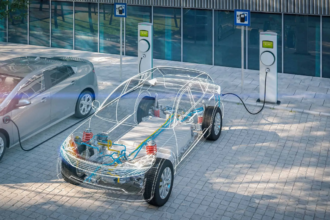
Electric Vehicle Technology covers much more than the battery sitting beneath a vehicle. It includes the battery cells and management system, electric motors, power electronics, charging hardware, thermal management, regenerative braking, vehicle software and the systems connecting the vehicle with the electricity grid.
A modern electric vehicle works more like a computer-controlled energy system than a traditional mechanical machine. Software can manage battery temperature, charging behaviour, energy consumption and many aspects of vehicle performance.
This architecture also gives manufacturers more freedom to introduce improvements through software and new electronic components. The International Energy Agency notes that the simpler mechanical structure of battery electric vehicles makes them particularly compatible with digitalisation and automation.
Why Batteries Remain the Centre of Electric Vehicle Technology
Battery development is still one of the most important areas of Electric Vehicle Technology. Battery capacity affects driving range, while charging performance, durability, weight, safety and manufacturing cost influence the overall ownership experience.
Lithium-ion batteries currently dominate the market, but research is moving in several directions. Sodium-ion batteries, solid-state batteries, and lithium-sulphur technologies are among the alternatives being developed, although their commercial prospects and suitability vary by application.
The important point for consumers is that progress does not require one revolutionary battery to suddenly replace everything else. Improvements to existing lithium-ion batteries can also produce meaningful gains in charging speed, energy density, manufacturing efficiency and durability.
Battery manufacturing is already operating at enormous scale. The IEA reported that global battery cell manufacturing capacity exceeded 3 TWh in 2024, while actual demand was much lower than total available capacity.
That difference matters because manufacturing scale can eventually support lower costs, but excess capacity does not automatically guarantee cheaper vehicles. Materials, labour, supply chains, tariffs, financing, and vehicle design all affect the final price.
Faster Charging Could Change How People Think About Range
Range anxiety has been one of the most persistent concerns surrounding electric vehicles. Electric Vehicle Technology is addressing that concern from two directions by improving battery efficiency and making charging considerably faster.
Public charging infrastructure is expanding rapidly. The IEA reported more than five million public charging points globally at the end of 2024, with more than 1.3 million added during that year alone.
Charging speed is improving too. Some manufacturers have demonstrated systems capable of adding substantial driving range within a few minutes, although those figures depend on the specific vehicle, battery condition, charger, and operating conditions.
For most drivers, however, the ideal charging experience may not mean charging as quickly as possible every time. Charging overnight at home can be more convenient than visiting a petrol station because the vehicle starts the day with energy already available.
The real challenge is ensuring that people who cannot charge at home have reliable alternatives. Apartment residents, renters, commercial drivers, and people who regularly travel long distances depend much more heavily on workplace and public charging.
Electric Motors Are Simpler and Highly Efficient
The electric motor is another reason Electric Vehicle Technology can transform vehicle design. Electric motors can deliver strong torque almost immediately, and electric drivetrains generally contain fewer moving mechanical components than conventional internal combustion powertrains.
That simplicity can reduce some forms of mechanical maintenance. Electric vehicles do not require conventional engine oil changes, and regenerative braking can reduce the use of friction brakes under suitable driving conditions.
Efficiency is equally important. The IEA estimated that global EV electricity consumption was about 180 TWh in 2024, while road transport activity continued to grow. Its analysis shows that increased electrification can deliver substantial energy efficiency gains compared with conventional road transport.
This does not mean electric vehicles consume no energy or have no environmental impact. Electricity generation, battery production, mining, manufacturing, and vehicle disposal all matter when assessing the complete environmental picture.
Software Is Becoming a Major Part of Electric Vehicle Technology
One of the less obvious changes is the growing importance of software. Modern EVs can monitor hundreds of operating conditions and continuously adjust how energy is used.
Battery management software is particularly important. It monitors temperature, voltage, and other parameters to help keep battery cells within appropriate operating conditions.
Software can also improve charging schedules. A vehicle can potentially charge when electricity is cheaper or when demand on the grid is lower, provided the necessary electricity pricing and charging infrastructure are available.
This creates an important connection between Electric Vehicle Technology and the wider energy system. The car is no longer simply a consumer of fuel. It can become a flexible electrical device.
Vehicle-to-Grid Could Turn Cars Into Energy Resources
Vehicle-to-grid technology, commonly called V2G, allows compatible electric vehicles to send electricity back to the grid. Smart charging can also shift charging to periods when electricity demand is lower without necessarily sending energy back to the grid.
The IEA reported in 2026 that smart charging and V2G can help reduce peak demand and provide flexibility to electricity systems. It also noted that commercial V2G offerings for private EV owners had begun appearing, although available models, regulations and standards remain limited in many markets.
The concept is promising, but it should not be oversold. Not every EV can currently provide bidirectional charging, and widespread V2G adoption requires compatible vehicles, chargers, electricity markets and regulations.
If those pieces come together, Electric Vehicle Technology could help transportation and electricity infrastructure work as one connected system.
Charging Infrastructure Will Matter as Much as the Cars
A brilliant electric vehicle is of limited value if drivers cannot conveniently recharge it. This is why the future of Electric Vehicle Technology depends heavily on infrastructure planning. Cities need charging options for people without private parking, while highways need dependable fast charging for long-distance journeys.
Grid capacity is another issue. Very powerful chargers can place substantial demands on local electricity networks, particularly when many vehicles charge simultaneously.
The IEA has highlighted this challenge while noting that battery storage and smarter charging can help manage the demands created by high-power charging.
In practice, the best charging network will not necessarily be the one with the highest charging power everywhere. Reliability, location, payment simplicity, uptime, and predictable pricing can be just as important to drivers.
Electric Trucks Could Reshape Commercial Transportation
Passenger cars receive most of the attention, but Electric Vehicle Technology could have an even more significant economic impact in commercial transportation.
Electric trucks are particularly attractive for predictable routes where vehicles return to a depot and can charge regularly. Delivery fleets, buses, municipal vehicles, and some regional freight operations can benefit from this pattern. Battery demand for electric trucks grew strongly in 2024, and the IEA reported another major increase in electric truck battery deployment in 2025.
Long-distance heavy transport remains more complicated because batteries add weight and require substantial energy. Charging infrastructure, payload requirements, route length, and operating schedules all need to be considered before choosing an electric truck.
For fleet operators, the right question is therefore not simply whether an electric truck has enough range. It is whether the entire operating cycle works economically.
Electric Vehicle Technology and Autonomous Driving
Electric vehicles and autonomous driving are often discussed together because both depend heavily on electronics, sensors, and software.
Electric drivetrains can make electronically controlled vehicle systems easier to integrate, while connected software architectures provide a useful foundation for advanced driver assistance.
That does not mean electric vehicles are automatically autonomous. Automated driving remains a separate technological challenge involving perception, decision-making, safety validation, regulations and human interaction.
The connection is nevertheless important. Electric Vehicle Technology is helping move vehicle engineering toward increasingly software-centred architectures, which can support future developments in automated transportation.
Battery Recycling Will Become Increasingly Important
As the global EV fleet grows, battery recycling and reuse will become increasingly important. A battery that is no longer suitable for automotive use may still have value in another application, depending on its condition and economics. The IEA notes that battery reuse is being developed, but economic and safety challenges can make repurposing complicated.
Recycling is equally important because recovered materials can potentially return to the manufacturing supply chain. However, recycling cannot instantly eliminate the need for newly mined materials because the number of retired EV batteries is still relatively small compared with the growing demand for new batteries.
The long-term goal should be a more circular battery industry in which manufacturers design batteries, vehicles, and recycling systems with the complete life cycle in mind.
What Electric Vehicle Technology Means for Drivers
For consumers, the most useful way to evaluate Electric Vehicle Technology is to focus on the actual driving routine rather than headline specifications.
Someone who drives mostly in a city and can charge at home may find an EV extremely convenient. A driver who lives in an apartment without charging access and regularly travels long rural routes may face a very different experience.
Purchase price is also only part of the calculation. Electricity costs, charging access, maintenance, insurance, financing, battery warranty, and expected resale value all influence the total cost of ownership.
Before buying, potential owners should check whether home charging is possible, how far they normally drive each day, what public chargers exist along their regular routes, and whether the vehicle supports the charging standards available in their area. This practical approach is more useful than assuming every EV is automatically cheaper or better for every driver.
The Environmental Question Is More Complicated Than Tailpipe Emissions
Electric vehicles produce no tailpipe exhaust while driving, which is a major difference from conventional petrol and diesel vehicles.
However, Electric Vehicle Technology does not make transportation impact-free. Battery production requires energy and raw materials, while the climate benefits of driving an EV depend partly on how the electricity used for charging is generated.
An EV charged using a relatively low-carbon electricity system has a different overall emissions profile from one charged primarily using electricity generated from fossil fuels.
The environmental picture also changes over time as electricity systems become cleaner and battery manufacturing becomes more efficient. For this reason, lifecycle analysis is more informative than focusing only on emissions from the exhaust pipe.
The Biggest Challenges Ahead
The future of Electric Vehicle Technology is promising, but several obstacles remain. Affordability is still important. Improvements in battery technology can reduce costs, but vehicles must also become accessible to households with different income levels.
Charging access is another major challenge. A charging network that works well in a wealthy urban area may not work equally well in smaller towns, apartment communities, or developing markets.
Supply chains also matter. Battery production remains geographically concentrated, creating economic and strategic risks for manufacturers and governments. The IEA reported that China accounted for about 80 percent of global battery cell production in 2024.
Cybersecurity will also become more important as vehicles become increasingly connected. The IEA has identified cybersecurity as a growing consideration for the EV sector as digital vehicle systems expand.
What the Next Decade Could Look Like
The future of transportation is unlikely to be defined by one technology replacing every other option. Battery electric vehicles are likely to become increasingly important for passenger cars, urban transport and many commercial applications. Other technologies may remain relevant where battery weight, charging infrastructure or operating conditions make full electrification difficult.
Electric Vehicle Technology will continue developing across batteries, motors, charging equipment, software and energy management rather than through a single breakthrough.
The IEA’s 2026 analysis indicates that battery deployment, charging technology and smart charging are all advancing, while grid integration is becoming an increasingly important part of the transition.
That is why the future should be judged not by how impressive one prototype looks, but by whether millions of ordinary people can use electric transportation conveniently, safely and affordably.
The Real Future of Transportation Is an Integrated System
Electric Vehicle Technology is ultimately changing the relationship between vehicles, roads, software and electricity.
The most important development may not be a vehicle with the longest range or the fastest acceleration. It may be a transportation system in which vehicles charge intelligently, batteries last longer, electricity networks respond to demand, and charging becomes as routine as connecting a phone.
Manufacturers are already experimenting with new battery chemistries, higher voltage architectures, advanced power electronics and more sophisticated software. At the same time, governments and energy companies are building the infrastructure needed to support larger electric fleets.
The category name Editor’s Choice fits the central lesson here: the most interesting EV developments are not necessarily the loudest announcements. The technologies that quietly improve charging reliability, battery durability, energy efficiency, and affordability may ultimately have the greatest effect on everyday transportation.
Electric Vehicle Technology has moved beyond being an alternative powertrain. It is becoming part of a broader transformation in how vehicles are manufactured, powered, maintained and connected to the energy system.
The road ahead will not be perfectly smooth. Costs, charging access, battery supply chains, grid capacity and consumer confidence will continue to shape adoption.
But the direction is increasingly clear. Transportation is becoming more electric, more digital, and more connected to the energy system, and Electric Vehicle Technology will be one of the central forces behind that change.