
The legal battle between OpenAI and Apple has entered a new phase after OpenAI asked a United States federal court to dismiss Apple’s Trade Secrets Case, describing it as meritless and fundamentally flawed. The dispute has quickly become one of the most closely watched legal confrontations in the artificial intelligence industry because it combines questions about intellectual property, employee mobility, and the future of AI hardware.
While Apple argues that confidential information was taken by former employees who later joined OpenAI, OpenAI strongly denies those claims and insists that Apple’s Trade Secrets Case lacks factual and legal support. The court has not yet ruled on the matter, meaning all allegations remain unproven.
What Is Apple’s Trade Secrets Case?
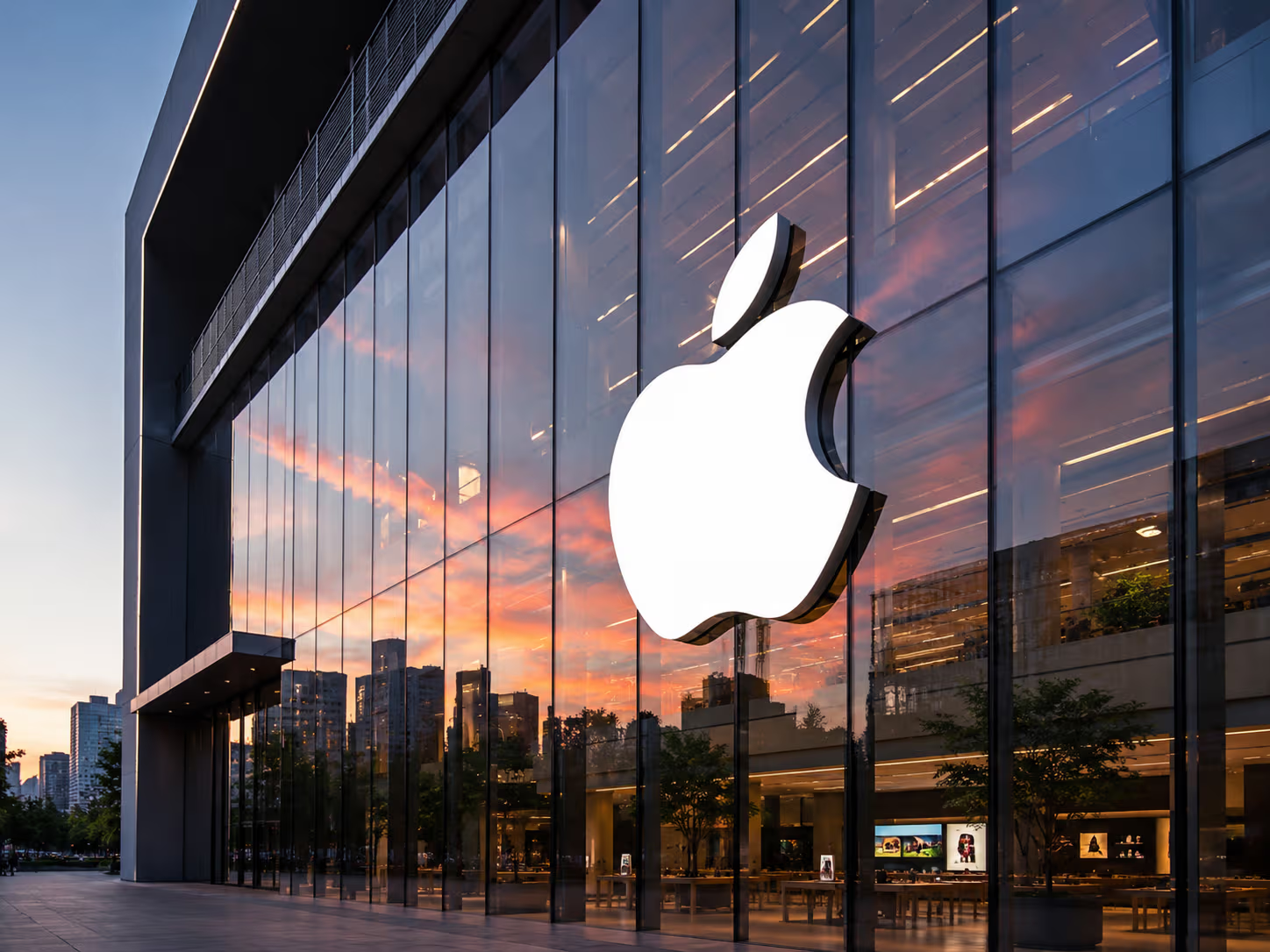
Apple’s Trade Secrets Case began after Apple accused OpenAI and several former Apple employees of misappropriating confidential company information connected to unreleased products, internal development processes, and hardware initiatives.
According to Apple’s complaint, certain former employees allegedly accessed sensitive documents before leaving the company and later used that information to benefit OpenAI’s expanding hardware ambitions. Apple has also requested a preliminary injunction to prevent the alleged use of any confidential material while litigation continues.
OpenAI has rejected these allegations and maintains that it has no interest in using another company’s proprietary information.
Why OpenAI Calls Apple’s Trade Secrets Case Meritless
OpenAI argues that Apple’s Trade Secrets Case should be dismissed because the complaint allegedly fails to identify actual trade secrets that were unlawfully taken or used.
In court filings, OpenAI reportedly described the lawsuit as “rotten to its core” and argued that Apple relied on misleading interpretations of evidence and conversations. OpenAI further claimed that many of Apple’s accusations involve information that either was not adequately protected or does not legally qualify as a trade secret.
The company also argues that Apple’s Trade Secrets Case reflects growing competition for AI talent rather than evidence of unlawful conduct.
Apple’s Position Remains Firm
Apple continues to defend Apple’s Trade Secrets Case, saying it has a responsibility to protect years of engineering work and confidential research.
The company alleges that former employees improperly retained sensitive files and shared confidential knowledge after joining OpenAI. Apple believes these actions could unfairly benefit a direct competitor developing future AI hardware products. At this stage, these remain allegations that OpenAI disputes.
The Bigger Issue Behind Apple’s Trade Secrets Case
Beyond the courtroom, Apple’s Trade Secrets Case highlights a growing challenge facing the technology industry.
Companies invest billions of dollars developing proprietary technologies while skilled engineers frequently move between employers. Courts often must determine where an employee’s experience ends and protected company information begins.
That distinction makes Apple’s Trade Secrets Case especially important because its outcome could influence how future AI companies recruit experienced talent without creating intellectual property disputes.
Competition in the AI Hardware Race
The timing of Apple’s Trade Secrets Case is notable.
OpenAI has significantly expanded its hardware ambitions following its acquisition of Jony Ive’s startup and the recruitment of several experienced Apple engineers. Apple, meanwhile, continues investing heavily in artificial intelligence and next-generation consumer devices.
Because both companies are pursuing advanced AI products, Apple’s Trade Secrets Case is being viewed by many industry observers as part of a broader competitive struggle rather than an isolated employment dispute.
What Happens Next?
OpenAI has formally requested dismissal of Apple’s Trade Secrets Case, while Apple continues seeking court intervention through a preliminary injunction.
If the judge denies OpenAI’s motion, the litigation could move into discovery, where both sides may be required to produce internal documents, communications, and additional evidence. If the motion succeeds, Apple’s Trade Secrets Case could end much sooner, although Apple may still have legal options depending on the court’s ruling. A hearing has been scheduled later this year.
Why the Technology Industry Is Watching Closely
Legal disputes involving trade secrets are not uncommon, but Apple’s Trade Secrets Case stands out because of the companies involved and the rapid pace of AI innovation.
Technology firms increasingly compete for engineers with specialized expertise in artificial intelligence, semiconductor design, and hardware engineering. The outcome of Apple’s Trade Secrets Case may shape future hiring practices, employee agreements, and intellectual property protections across the AI sector.
For readers following developments in Tech Insider, this lawsuit represents more than a disagreement between two technology giants. It reflects the legal and competitive pressures that accompany the race to build the next generation of AI-powered devices.
Apple’s Trade Secrets Case remains in its early stages, and no court has determined whether Apple’s allegations are valid. OpenAI insists the lawsuit is meritless and should be dismissed, while Apple argues it is protecting confidential innovations developed over many years.
Until the court reviews the evidence and reaches a decision, Apple’s Trade Secrets Case should be viewed as an ongoing legal dispute rather than proof of wrongdoing by either side. Whatever the outcome, the case is likely to influence how technology companies balance innovation, employee mobility, and trade secret protection in the rapidly evolving AI industry.