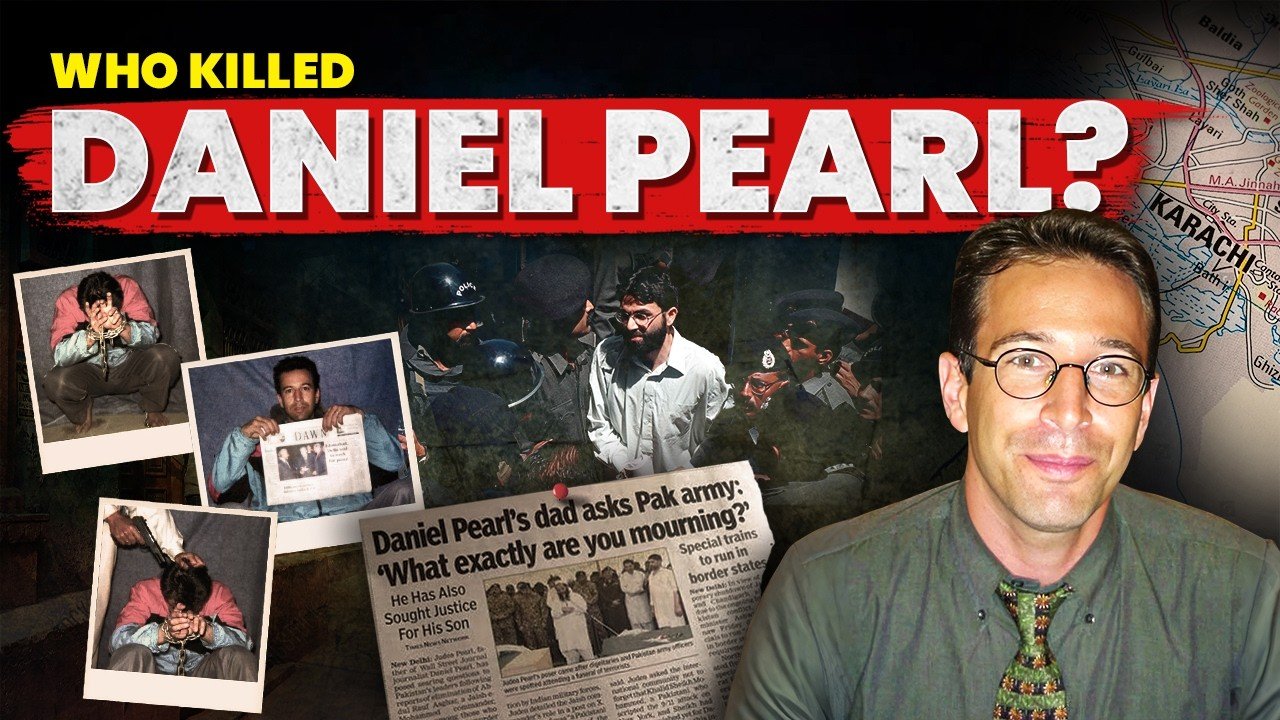

On the evening of January 23, 2002, American journalist Daniel Pearl left for what he believed would be one of the most important interviews of his career. He was in Karachi, Pakistan, investigating the connections between international terrorism, extremist networks, and Richard Reid, the British terrorist known as the Shoe Bomber. He expected to return home that night. Instead, he disappeared into a conspiracy that would become one of the most disturbing cases in modern journalism.
Daniel Pearl was the South Asia bureau chief for The Wall Street Journal. He had traveled to Pakistan to investigate a lead involving Mubarak Ali Shah Gilani, a religious figure whose alleged connections to extremist networks had attracted international attention. The interview could have helped answer important questions about the movement of militants across borders following the September 11 attacks.
- Who Was Daniel Pearl Before the Tragedy?
- How the Daniel Pearl Kidnapping Was Planned
- Four Days of Silence and a Chilling Message
- The Murder That Shocked the World
- Finding Daniel Pearl’s Remains
- Ahmed Omar Saeed Sheikh
- The Court Decisions That Renewed the Controversy
- The Truth Behind Daniel Pearl’s Death
- Why the Daniel Pearl Case Still Matters
- A Journalist Remembered Beyond the Headlines
- My Personal Opinion
But the meeting never took place as planned.
After arriving near the Village Restaurant in Karachi, Pearl received a phone call informing him that the location had changed. The person arranging the interview told him that he would need to travel elsewhere to meet Gilani. A white car arrived, and Pearl got inside.
That decision marked the beginning of the Daniel Pearl Case, a tragedy that would expose the dangers facing journalists who investigate terrorism and reveal the complicated struggle to bring those responsible to justice.
As the hours passed, Pearl failed to return to the home where he was staying. His pregnant wife, Mariane Pearl, became increasingly worried. His phone was switched off, and no one could explain where he had gone.
At first, there was hope that the disappearance might be resolved quickly. However, as the night turned into the following day, the situation became increasingly alarming. What began as a missing journalist investigation soon developed into an international crisis.
Who Was Daniel Pearl Before the Tragedy?
To understand the Daniel Pearl Case, it is important to understand the journalist behind the headlines. Pearl was not simply an American reporter who had traveled to a dangerous country. He was an experienced correspondent who believed that careful reporting could help people understand the forces shaping the world around them.
Born on October 10, 1963, in Princeton, New Jersey, Daniel Pearl grew up in an intellectually engaged family. His father, Judea Pearl, became a prominent computer scientist, while his mother, Ruth Pearl, came from an Iraqi Jewish family.
Daniel eventually studied communication at Stanford University. After graduating, he began his journalism career at regional newspapers, including The Berkshire Eagle and The North Adams Transcript. These early assignments gave him valuable experience interviewing ordinary people, investigating local issues, and developing the patience required for serious reporting.
In 1990, Pearl joined The Wall Street Journal. His career took him to several major cities, including Atlanta, Washington, London, and Paris. He became known for his curiosity, international perspective, and ability to build stories from conversations and details that other reporters might overlook.
In 2000, he became the newspaper’s South Asia bureau chief, based in Mumbai, India. His work increasingly brought him into contact with political tensions, religious extremism, and the changing security environment across South Asia.
Following the September 11, 2001, terrorist attacks in the United States, these subjects became even more urgent. Investigators, intelligence agencies, and journalists were trying to understand how extremist organizations operated across national boundaries.
The Daniel Pearl Case would eventually demonstrate the personal risks associated with pursuing those questions. Yet his final assignment was not an isolated act of recklessness. It emerged from years of professional experience and a determination to understand the networks behind major international events.
The Shoe Bomber and the Story That Led Pearl to Pakistan
The background to the Daniel Pearl investigation can be traced to Richard Reid, who became internationally notorious in December 2001.
Reid attempted to detonate explosives concealed in his shoes aboard an American Airlines flight traveling from Paris to Miami. When the explosives failed to ignite as intended, he attempted to set them alight manually. Passengers and crew members intervened, and he was eventually restrained and arrested.
The incident raised serious questions about airport security and the international networks that supported extremist violence.
For Daniel Pearl, the important question was not simply what Reid had attempted to do. He wanted to understand the people, organizations, and ideological influences that might have helped shape the British terrorist.
A report published by The Boston Globe in January 2002 discussed an alleged connection between Reid and Mubarak Ali Shah Gilani, the founder of Jamaat ul Fuqra, a religious organization that had attracted scrutiny over alleged extremist links.
That report gave Pearl a potential lead worth pursuing. If the connection could be established and properly documented, it might help explain how individuals from different countries became involved in transnational militant networks.
The Daniel Pearl final assignment therefore centered on more than one suspected relationship. It involved questions about recruitment, radicalization, and the international reach of extremist organizations.
Pearl traveled from Mumbai to Karachi to pursue the story. He arranged contacts through local intermediaries and tried to secure an interview with Gilani.
What he did not know was that the arrangements would lead him into a kidnapping.
How the Daniel Pearl Kidnapping Was Planned
The Daniel Pearl kidnapping unfolded through a series of meetings, phone calls, and promises that gradually brought the journalist closer to danger.
According to the account presented in the source script, a local journalist helped Pearl establish contact with a man identified as Bashir, who claimed to have access to Gilani. Pearl met him in Rawalpindi on January 11, 2002. They subsequently communicated by telephone and email while attempting to arrange the interview.
The meeting was repeatedly delayed. Sometimes Pearl was told that Gilani had left the area. At other times, security concerns supposedly required a change of location.
For an investigative journalist, delays are not necessarily unusual. Important sources may be difficult to reach, particularly when an investigation concerns sensitive political or security matters. Pearl continued pursuing the interview because he believed the lead might be significant.
On January 23, he was told that the interview would finally happen at the Village Restaurant in Karachi.
Before leaving, Pearl shared his plans with his wife and other contacts. He expected to return later that evening. When he arrived near the restaurant, however, he received another call. The meeting location had changed again.
The person arranging the interview directed him to another location outside the restaurant. Pearl subsequently entered a white car and disappeared.
Investigators later identified Ahmed Omar Saeed Sheikh as a central figure in the kidnapping plot. Sheikh had a history of involvement in hostage taking and militant activity. He had previously been convicted in India for his role in the kidnapping of Western tourists and was released in 1999 as part of the negotiations surrounding the hijacking of Indian Airlines Flight IC 814.
The Daniel Pearl murder investigation would later establish Sheikh’s role in the events surrounding Pearl’s abduction. However, questions about who personally killed Pearl and how responsibility should be assigned became central to the subsequent legal proceedings.
The kidnapping also demonstrated how an apparently routine professional arrangement could be manipulated into a carefully prepared trap.
Four Days of Silence and a Chilling Message
When Daniel Pearl failed to return, Mariane Pearl contacted him repeatedly. His phone remained switched off, and the uncertainty surrounding his whereabouts grew more frightening with every passing hour.
Authorities in Pakistan and the United States became involved in the search. The disappearance of an American journalist investigating terrorism attracted international attention, placing pressure on investigators to find him quickly.
On January 27, 2002, an email arrived containing photographs of Pearl in captivity. He appeared restrained, with a weapon pointed at him. The message included demands directed at the United States, including the release of Pakistani prisoners and the resumption of military equipment supplies to Pakistan.
The group claiming responsibility described Pearl as an intelligence agent, accusations that were used to justify the kidnapping and attempt to turn his captivity into a political weapon.
The photographs confirmed that Pearl had been abducted. They also made the danger unmistakable.
The Daniel Pearl Case had now become an international hostage crisis. Officials faced the difficult task of investigating the kidnapping while trying to establish Pearl’s location and determine whether he was still alive.
For his family, the photographs represented a devastating change in circumstances. The journalist who had left for an interview only days earlier was now being used to deliver demands to governments.
The kidnappers were not merely seeking information or money. They were attempting to use a human life to influence international policy and promote their ideological message.
The Murder That Shocked the World
On February 21, 2002, authorities in Karachi received a videotape showing Daniel Pearl’s murder. The footage documented his forced statement and killing and was accompanied by extremist propaganda.
Investigators determined that Pearl had been killed weeks earlier, on February 1, while still in captivity.
The discovery transformed the Daniel Pearl Case from a desperate search for a missing journalist into a murder investigation with international consequences.
The video was intended to spread fear and promote the kidnappers’ political message. Pearl was forced to identify himself and speak about his Jewish identity before he was killed. The perpetrators attempted to portray him as an enemy of their cause, using his death to reinforce their propaganda.
The violence was horrifying, but the circumstances surrounding it were equally revealing. A journalist investigating extremist networks had been turned into a target, and his murder was deliberately recorded to reach a global audience.
News organizations faced difficult decisions about whether to publish or broadcast details from the footage. Reporting on the murder was necessary to inform the public, but reproducing graphic material risked amplifying the perpetrators’ propaganda and causing further distress to Pearl’s family.
The Daniel Pearl murder case became a symbol of the dangers faced by reporters working in conflict zones. It also raised difficult questions about the responsibilities of governments, media organizations, and international institutions when journalists are targeted for their work.
Pearl’s death was not simply an attack on one person. It was an attempt to silence a reporter and intimidate others who might investigate similar subjects.
Finding Daniel Pearl’s Remains
Even after authorities learned of the murder, the investigation continued. Investigators needed to locate Pearl’s remains, identify those involved, and establish how the kidnapping had been organized.
A breakthrough came through the examination of communications associated with the kidnappers. Investigators followed digital leads and questioned suspects connected to the case.
On May 16, 2002, Pakistani investigators located Pearl’s remains in the Gadap area near Karachi. The discovery brought an end to the search for his body, although it did not resolve every question surrounding the crime.
The Daniel Pearl murder investigation subsequently focused on several suspects, including Ahmed Omar Saeed Sheikh and men accused of assisting the kidnapping.
The investigation revealed how the crime had involved more than the person who arranged the initial meeting. The abduction required people who could establish contact with Pearl, transport him, hold him captive, and participate in the wider conspiracy.
Such cases are rarely solved through one piece of evidence alone. Investigators must examine communications, witness statements, physical evidence, and the relationships among suspects. They must also distinguish between evidence that establishes participation in a kidnapping and evidence that proves responsibility for a murder.
That distinction would become particularly important as the Daniel Pearl Case moved through Pakistan’s courts.
Ahmed Omar Saeed Sheikh
Ahmed Omar Saeed Sheikh became one of the most prominent figures associated with the Daniel Pearl Case.
Born in the United Kingdom, Sheikh studied at the London School of Economics before becoming involved in extremist activity. His background and education allowed him to communicate comfortably with Westerners, a capability that was relevant to his earlier kidnapping activities.
Sheikh had been arrested in India in connection with the 1994 kidnapping of foreign tourists. His release during the 1999 hijacking crisis later became an important part of his history.
In the Pearl investigation, prosecutors alleged that Sheikh played a central role in arranging the abduction. The use of a false identity and the promise of access to a potential interview subject were central to the account of how Pearl had been lured into captivity.
In July 2002, a Pakistani anti terrorism court convicted Sheikh and three other men in connection with the case. Sheikh received a death sentence, while the others received prison terms.
At the time, the convictions appeared to provide a clear legal outcome. However, the question of who had physically carried out the murder remained a matter of considerable controversy.
In 2007, Khalid Sheikh Mohammed, a senior al Qaeda figure held in United States custody, reportedly claimed responsibility for personally killing Pearl. The claim complicated the legal and historical understanding of the crime.
A confession or claim of responsibility, however, must be assessed alongside other evidence. It does not automatically settle every question about who planned, facilitated, or carried out a criminal act. Several people may bear different forms of responsibility for a kidnapping and murder.
The Daniel Pearl Case consequently became not only a story about terrorism but also a complicated legal dispute over evidence, culpability, and the limits of criminal proceedings.
The Court Decisions That Renewed the Controversy
The legal history of the Daniel Pearl Case took another dramatic turn in 2020, when the Sindh High Court overturned the murder convictions of Sheikh and the other men. The court’s decision altered the legal status of the accused and triggered widespread criticism.
Pearl’s family challenged the outcome, arguing that the ruling undermined accountability for the journalist’s murder. The case continued through Pakistan’s judicial system, attracting international attention and renewed scrutiny of the evidence.
In January 2021, Pakistan’s Supreme Court upheld the acquittals in a decision that provoked further controversy. The court’s actions did not erase the fact that Pearl had been kidnapped and murdered. Instead, they intensified disagreement over the criminal responsibility of the individuals convicted in the original proceedings.
This distinction matters when examining the Daniel Pearl Case. A judicial decision about whether particular defendants have been proved guilty under the applicable law is not the same as a finding that the crime never happened or that no one was responsible.
The case exposed the difficulty of securing lasting convictions in politically sensitive terrorism investigations. It also demonstrated how conflicting accounts, questions about evidence, and lengthy appeals can leave victims’ families without the sense of closure they seek.
For Judea and Ruth Pearl, the legal struggle was inseparable from their loss. For Mariane Pearl and the couple’s son, Adam, the consequences were deeply personal.
The wider public also had reason to pay attention. When the murder of a journalist becomes the subject of years of legal uncertainty, the case raises questions about the protection of reporters and the ability of legal institutions to hold perpetrators accountable.
The Truth Behind Daniel Pearl’s Death
The Truth behind Daniel Pearl’s death cannot be reduced to a single name or one courtroom decision. The central facts are clear. Pearl traveled to Pakistan as a journalist, was lured into a kidnapping, was held by extremists, and was murdered in February 2002. His death was recorded and used to spread propaganda.
The more complicated questions concern the complete chain of responsibility. Who planned the operation? Who arranged the meeting? Who assisted the kidnappers? Who held Pearl captive? And who carried out the killing?
These questions require careful distinctions between documented events, allegations made by investigators, statements from suspects, and findings reached by courts.
The Daniel Pearl Case illustrates why responsible historical reporting must resist the temptation to treat every claim as fact. Confessions may be disputed, witnesses may provide conflicting accounts, and court rulings may turn on specific legal standards. A trustworthy account should explain these uncertainties without losing sight of the underlying crime.
Pearl’s murder also demonstrated how extremist groups use propaganda to transform violence into a political performance. By recording the killing and circulating the footage, the perpetrators sought to intimidate audiences far beyond the place where the crime occurred.
The strategy depended on the global reach of media and the public’s understandable desire to learn what had happened. It also placed journalists and editors in a difficult position, requiring them to report the facts without becoming instruments of the perpetrators’ campaign.
Understanding the Daniel Pearl murder investigation therefore involves more than reconstructing a timeline. It requires examining how deception, ideology, political demands, and weaknesses in accountability combined to produce a tragedy with consequences far beyond Karachi.
Why the Daniel Pearl Case Still Matters
More than two decades after Pearl’s murder, the Daniel Pearl Case remains an important example of the risks faced by journalists investigating terrorism and political violence.
Reporters often work in places where reliable information is difficult to obtain. They must build relationships with sources, assess competing claims, and decide whether a potential lead justifies the risks involved. Those responsibilities become especially difficult when the people being investigated are connected to armed groups or clandestine networks.
Pearl’s experience offers a sobering lesson about source verification and personal security. Journalists should confirm the identity of intermediaries, independently verify meeting arrangements, share travel plans with trusted colleagues, and establish clear check-in procedures when reporting in high-risk environments. A last-minute change of venue should prompt a fresh assessment of the risks, particularly when the destination is isolated or the meeting depends on an unverified contact.
These precautions cannot eliminate every danger. They can, however, help reporters and their organizations identify warning signs before a situation becomes irreversible.
The Daniel Pearl Case also highlights the importance of supporting journalists after an abduction or threat. News organizations need effective emergency protocols, reliable local contacts, clear communication plans, and access to professional security advice. Governments must investigate attacks on journalists seriously and ensure that criminal proceedings are supported by credible evidence and fair legal processes.
Pearl’s story also reminds readers that journalism is not merely the act of publishing information. It involves asking difficult questions, challenging convenient explanations, and documenting events that powerful or violent groups would prefer to keep hidden.
His death did not answer every question he had been investigating. Yet his work and the circumstances of his murder continue to shape discussions about terrorism, press freedom, and accountability.
A Journalist Remembered Beyond the Headlines
Daniel Pearl left behind a grieving family, unfinished reporting, and a case that continues to provoke debate. His murder became one of the most recognizable examples of a journalist being targeted during an investigation into extremist networks.
His parents, Judea and Ruth Pearl, worked to preserve his memory and promote dialogue through initiatives associated with his name. The Daniel Pearl Foundation, established in his honor, supports efforts connected to journalism, intercultural understanding, and the values he represented.
Remembering Pearl should not mean turning his life into a story of tragedy alone. His career was defined by curiosity, professional commitment, and a desire to understand people and events beyond familiar boundaries.
The Daniel Pearl Case remains painful because it combines the loss of a human life with unresolved questions about responsibility and justice. It also shows how a journalist’s pursuit of information can collide with organizations that use violence to control the narrative.
Pearl went to Karachi looking for answers about a possible connection between a terrorist and extremist networks. He never returned to complete that assignment. But the investigation into his kidnapping and murder continues to provide lessons about source verification, the dangers of propaganda, and the importance of credible justice.
His story is a reminder that the freedom to investigate and report the truth cannot be taken for granted. Protecting that freedom requires more than honoring journalists after they are killed. It requires practical safety measures, responsible reporting, effective investigations, and legal systems capable of holding perpetrators accountable.
The Daniel Pearl Case remains a tragedy, but it is also a lasting warning about what happens when violence is used to silence questions. Daniel Pearl’s name endures because the questions he pursued still matter, and because the world continues to struggle with the challenge of protecting those who seek answers.
My Personal Opinion
Inside the Daniel Pearl Case lies a story of journalistic courage, calculated deception, brutal violence, and a prolonged struggle over justice. Pearl’s final assignment in Pakistan began with an effort to understand the international connections behind terrorism. It ended with his kidnapping and murder, followed by years of investigation and legal controversy.
The case continues to matter because accountability for attacks on journalists is essential to the public’s right to know what is happening in the world. It also reminds reporters that professional determination must be balanced with careful risk assessment, independent verification, and reliable safety procedures.
Daniel Pearl’s life should be remembered for more than the circumstances of his death. He was a journalist who pursued difficult stories because he believed that understanding the truth mattered. His legacy endures in the continuing effort to protect press freedom, investigate violence responsibly, and ensure that the murder of a reporter does not become an acceptable cost of seeking the truth.